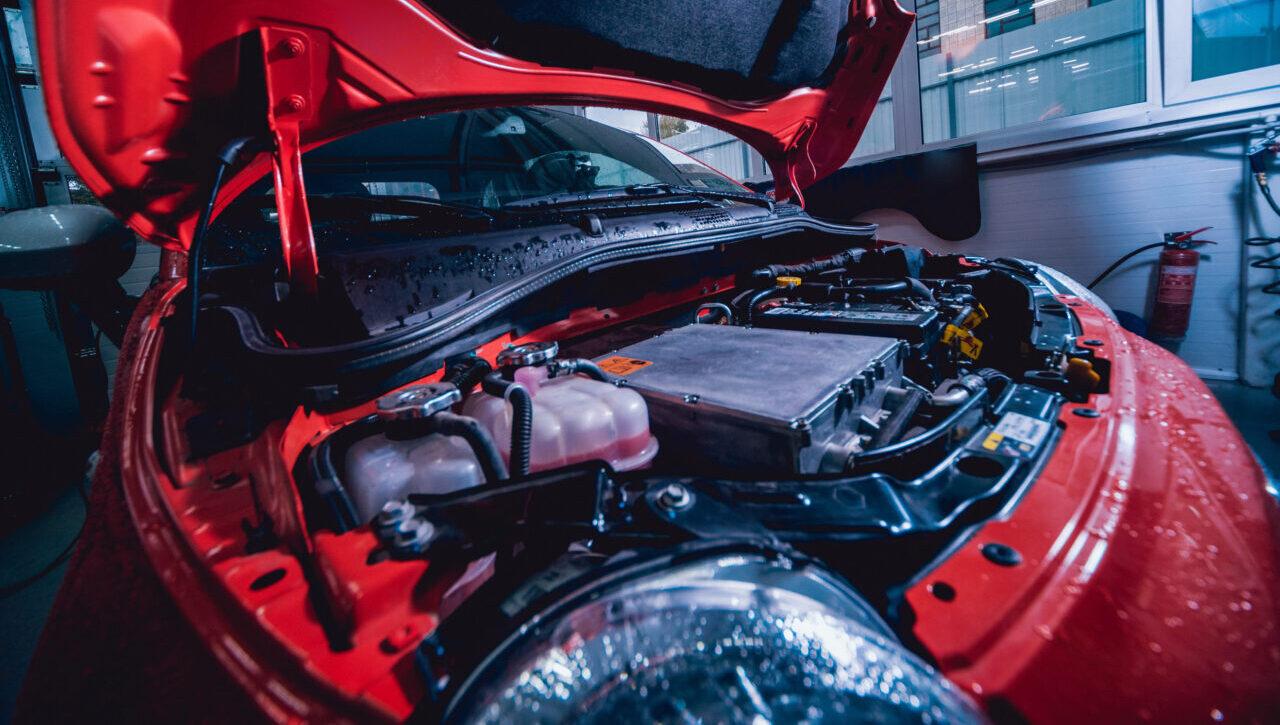
 Motore auto elettrica
Hybrid and Electric Cars in the Workshop: Safety Doesn’t Stop at Certificates. Here’s What to Do
The safety of hybrid and electric cars is not measured by the certificates hanging on the wall, but by the ability to apply procedures, use the correct tools and manage real risks. A complete guide created together with EVSAFE
The safety of hybrid and electric cars is not measured by the certificates hanging on the wall, but by the ability to apply procedures, use the correct tools and manage real risks. A complete guide created together with EVSAFE
The electric transition arrived in the workshop before the workshop culture was ready to welcome it. Vehicles with 400 or 800 volt traction systems, battery packs that easily exceed several tens of kilowatt-hours of stored energy, sophisticated thermal management systems, software that decides when a component is really “isolated”: all this coexists with tools, habits and even physical layouts that, in many Italian workshops, are still calibrated to a “petrol” world.
To understand what it really takes to work safely on electrified vehicles, the SICURAUTO.it editorial team – as part of the 6th Aftermarket Report – gathered input from the specialists at EVSAFE, an Italian company active in maintenance, repair, post-accident management and training dedicated to electric and hybrid vehicles. The result is a practical guide that addresses, through questions and answers, some of the most relevant issues for the car repair sector: from regulatory requirements to professional qualifications, from the necessary equipment to operating procedures, through to emergency management and the handling of accident-damaged vehicles.
The aim is to provide practical, field-based guidance, distinguishing between regulatory obligations, good practices and mistakes to avoid. Because the safety of hybrid and electric cars does not depend only on the certificates obtained, but on the ability to correctly apply procedures, use the appropriate tools and consciously manage the risks associated with high-voltage interventions.
📊
This content is part of SICURAUTO.it’s 6th Aftermarket Report, titled: “The Aftermarket in the Era of European Regulations: Opportunities, Constraints and New Specializations”.
What are the minimum regulatory requirements for a workshop that wants to work on electric vehicles today?
Until very recently — and it is worth knowing this from the outset — Italy had no standard written specifically for electric vehicle traction systems. The applicable regulatory framework was built “by extension”, combining a technical standard created for fixed electrical systems with general legislation on safety at work. The operational reference has so far been CEI 11-27 in its sixth edition of 2025, read together with CEI EN 50110-1 (CEI 11-48) and Legislative Decree 81/2008, in particular Articles 82 and 83 of the Consolidated Safety Act, which prohibit work on live parts without qualified personnel and formalized procedures. Since 5 November 2026, this framework has been complemented by a vehicle-specific document: the CEI 78-24 Technical Specification.
THE STEP CHANGE HAS ARRIVED: TECHNICAL SPECIFICATION CEI 78-24
The regulatory framework has changed substantially. On 5 November 2026, the Italian Electrotechnical Committee published the CEI 78-24 Technical Specification “Management of electrical risk on electric and hybrid vehicles — Part 1: activities on vehicles”, which came into force immediately upon publication. The document is the outcome of project PRJ-3518, whose public consultation closed on 24 February 2025. It is the first real Italian standard written expressly for electrical risk in vehicles, and it had been awaited for years: CEI 11-27, which until now had been applied “by analogy”, was created for fixed systems and shows its limitations when applied to vehicles.
For those who manage a workshop, CEI 78-24 introduces some substantial changes, which apply with immediate effect (read our in-depth feature on the CEI 78-24 standard, created together with the Italian Electrotechnical Committee):
- Vehicle-specific professional roles. In addition to PES, PAV and PEC, the Specification defines the Vehicle Operator (GV) — equivalent to the CEI 11-27 Installation Operator — and the Person Responsible for the Vehicle (RV), typically the workshop manager, a PES (possibly also PEI) responsible for vehicle intake and for identifying the type of work to be carried out;
- Explicit classification of work: dead working, live working, work in the vicinity of live parts, non-electrical work with electrical hazard (e.g. bodywork, washing, handling). Each requires a different qualification and procedure;
- Dedicated training course on electric and hybrid vehicles, divided into two levels: theoretical level 1 (minimum 12 hours) for those who have organizational responsibilities or perform non-complex work; operational level 2 for those who work hands-on on battery packs and live parts;
- Priority of the manufacturer’s instructions: the Technical Specification explicitly states that the vehicle manufacturer’s instructions take precedence over the regulatory requirements. This is a good practice that too many workshops still ignore.
THE THREE TECHNICAL ROLES CURRENTLY IN FORCE (CEI 11-27)
- PAV (Instructed Person) — operator who has received formal instruction on electrical hazards and who works under the supervision of a PES. This role is typically held by a junior mechatronics technician in training;
- PES (Skilled Person) — has sufficient knowledge, experience and analytical skills to plan the job, assess the electrical risk and direct the work. At least one PES must be present during each HV intervention;
- PEI (Person Qualified for Live Working) — additional qualification, recognized by the employer, which authorizes the holder to work on parts that are actually live. Attending a course is not enough: the qualification must be granted in writing;
WHAT THE WORKSHOP MUST HAVE, IN PRACTICE
Translated into operational obligations, a workshop that wants to comply with the law must be able to demonstrate at least these points:
- Update of the DVR (Risk Assessment Document) with a specific item for the electrical risk from HV traction — covering only the electrical risk from “fixed installations” is not enough;
- Documented training according to CEI 11-27 ed. 2025 with a theoretical and — above all — practical component on real vehicles, aligned with the contents of the new CEI 78-24;
- Written safety procedures, including the LOTO (Lockout/Tagout) procedure on the service disconnect and the make-safe checklist;
- At least one PES physically present at each intervention on the HV system: no “on-the-fly” work on battery pack or orange cables without qualified supervision;
- 1000 V insulated PPE and tools compliant with the reference technical standards (IEC 60900 for tools, EN 60903/EN 50365 for PPE), with a periodic inspection log.
WHY FORMAL QUALIFICATION IS NOT ENOUGH: A REALISTIC SCENARIO
PES status is not a title that the technician carries around in his pocket: it is a formal act by which the employer grants, in writing, a qualification to a specific person, within a specific technical scope. This is where real responsibility lies, and where we see the most frequent mix-ups happen.
Let’s imagine a not infrequent case. A body shop owner hires a new workshop manager with a valid PES/PAV/PEI certificate, obtained a few years earlier by attending a standard electrical safety course — industrial electrical panels, domestic installations, live work on fixed systems. On paper, everything adds up: the employer formally appoints the PES, updates the DVR, archives the certificates. Six months later, the first seriously damaged electric sedan arrives at the workshop: the workshop manager, trusting his certificate, decides to remove the battery pack for verification. He is familiar with the LOTO procedure on substation switchboards, but he has never heard of model-specific DC-link discharge times, non-standardized color codes between Chinese and German manufacturers, service disconnect variants that require precise sequencing in order not to ignite an arc. Even if nothing dramatic happens — maybe just a persistent BMS error, or an insulation test that returns suspect readings, or a small arc at disengagement — the employer already has a serious problem: the PES was appointed for a scope in which he was not actually competent, and in the event of an incident, the insurance cover may not pay out and criminal liability falls back on the person who made the appointment.
It is precisely for this reason that the new CEI 78-24 introduces a dedicated and graduated training course (level 1 theoretical, level 2 operational) and that we, at EVSAFE, provide specific PES/PAV/PEI training for electric and hybrid vehicles on real vehicles — not at classroom desks, where no real car has ever been.

Which “best practices” are not mandatory but strongly recommended?
The regulatory framework defines the legal minimum; the professional practice of those who work seriously on electric vehicles always goes one step further. The following practices are not prescribed by a mandatory standard, but represent the technical standard that we expect to find in a serious workshop — and that we demand from partner centers that join the EVSAFE network.
PHYSICAL ORGANIZATION OF SAFETY
- Dedicated and marked EV work area, with physical delimitation (chains, posts, “Electrical work in progress — do not approach” signs) set up every time work is carried out on the HV system. It is not a formality: it prevents a colleague from walking past the lift and accidentally touching an orange cable;
- Physical separation between the intervention area, the charging area and the battery storage area. Three activities with different risk profiles that must never overlap;
- Certified container or cabinet for damaged or suspect batteries, consistent with ADR SP 376 / Packing Instruction P911 and — for extended storage — with guidelines such as VDMA 24994. A suspect battery is not simply left “in a corner”.
PROCEDURES AND TECHNICAL CULTURE
- Emergency plan agreed with the local Fire Brigade and communicated to the insurance company, with a specific procedure for thermal runaway. It is much more effective to introduce yourself to the local Fire Brigade when things are calm than to call them while the battery pack is smoking (we discuss workshop fire safety with Emme Antincendio in a dedicated feature, ed.);
- Rotation and periodic updating of PES/PAV/PEI training at intervals not exceeding five years — international good practice — with a significant share of hands-on practice, not just classroom theory. With CEI 78-24 now in force, this is complemented by the vehicle-specific training levels (level 1 and level 2);
- Digital traceability of HV operations: signed checklists, pre/post intervention photos, instrument logging of insulation measurements. This is what makes the difference in the event of an accident or dispute;
- Cross-validation (“second pair of eyes”) on interventions that directly touch the traction battery;
- Training also for non-technical personnel: vehicle intake, washing, vehicle storage. Anyone who moves a car in the yard or sprays it with a pressure washer must know how to recognize an electric vehicle and what not to do.
These practices are not optional extras to pick and choose from: they are the necessary condition to sustain the level of safety expected of those who work professionally on electric vehicles. It is the cultural leap between “being compliant” and “being safe”.

What is the concrete difference between a technician trained “on paper” and one who is actually able to operate safely?
This is the question we hear most often from owners and technical managers. The honest answer is: the difference is wide, it is daily and cannot be bridged with another classroom course. It is bridged through repeated exposure to real vehicles, with coaching and with a work culture that rewards those who measure and track, rather than those who go fast.
The PES/PAV/PEI certificate shows that the technician has acquired the knowledge: it is a necessary condition. It does not prove that he applies it under pressure, at 6:30 pm on a Friday, on an angry customer’s accident-damaged car. The quality of a “safe” technician lies in the details, and can be seen at a glance as soon as he walks into the workshop.
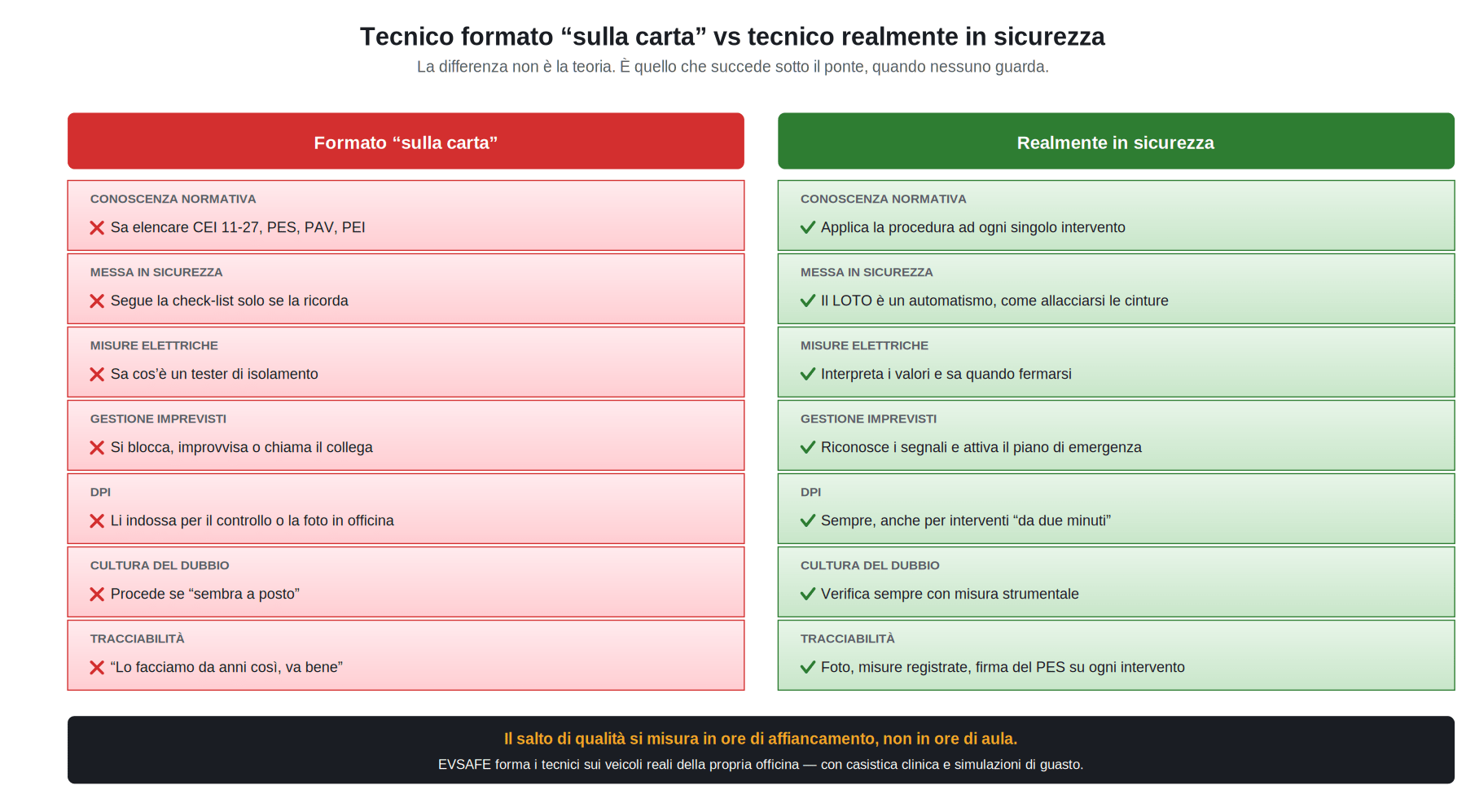
Figure: Practical differences between a technician trained “on paper” and one who truly works safely.
THE SIX DIMENSIONS OF DIFFERENCE
In short, these are the six dimensions in which the experienced technician stands out from the merely qualified one. Each of them, in turn, is the result of weeks of supervised practice.
- Regulatory knowledge: moving from quoting CEI 11-27 by heart to applying it automatically — he knows which clause applies at which stage of the job, and keeps up to date with the new CEI 78-24 and how it is applied;
- Making safe: the mature technician does not “remember” the LOTO checklist, he performs it automatically, in the same way he puts on his seatbelt when he gets into the car;
- Electrical measurements: he knows what an insulation tester is, but above all he knows how to interpret the value — he understands when a “low” megohm reading is still normal and when work must stop immediately;
- Handling the unexpected: faced with a BMS that returns an unexpected error, he does not improvise: he recognizes the signal, stops the intervention and activates the written emergency plan;
- PPE: he wears dielectric gloves, helmet, visor and insulating shoes even for a “two-minute” job. He knows that electrical risk is binary: it is either there or it is not, and it does not scale with time;
- Culture of doubt: he does not proceed just because it “seems fine”. He verifies with instrument measurements. It is the difference between the professional and the amateur.
A clear message for readers: training creates the qualification. Supervision makes the professional. Corporate culture and continuous updating make safety.
What practical mistakes do newly trained technicians make most often?
Our direct experience in the workshop and in the EVSAFE classroom allows us to identify some recurring patterns. These are not mistakes of bad faith: they are the product of training that is often too “slide-based” and of an industry that has not yet codified the transition from theory to HV practice. Knowing them is the first step to avoiding them.
THE MOST FREQUENT MISTAKES
- Considering the vehicle “off” because the ignition is off. The HV system may remain energized for minutes after shutdown, due to the DC-link capacitors. Off does not mean discharged;
- Skipping the absence-of-voltage test before touching HV components. This is the most important step in the safety procedure, and it is the one most often “assumed” rather than verified;
- Using inadequate or outdated PPE: generic workshop gloves instead of dielectric ones, or dielectric gloves that have expired or not been tested in the previous six months. An untested dielectric glove is not PPE: it is a placebo;
- Confusing “de-energized” with “isolated”. An unenergized orange cable is still an HV component — it should be treated with the same care, because it can be reactivated by mistake;
- Omitting LOTO (tagging and physical locking of the service key): in small workshops, where “everyone knows each other”, people sometimes skip the lockout. All it takes is an unsuspecting colleague who reactivates the vehicle to turn the accident into a tragedy;
- Applying CEI 11-27 “by analogy”. The standard was created for fixed electrical systems and someone concludes — wrongly — that it does not apply to vehicles because “it doesn’t say vehicles”. This is exactly the gap that CEI 78-24 has now filled;
- Underestimating the risk in bodywork: hammer blows, welding, localized heating near the battery pack without first disconnecting it. An impact that is not visible from the outside can trigger a thermal event hours later.
THE ROOT MISCONCEPTION: “BOLT-ON” TRAINING
There is a misinterpretation that precedes all operational errors, and it is of a cultural nature. A significant part of the training offer currently in circulation consists of the classic PES/PAV/PEI course on fixed electrical systems — the one that many trainers have been providing for ten years — to which some generic concepts on electric vehicles have been added at the end: the orange color of the cable, the BMS block diagram, a few slides on lithium batteries. Content often drawn from superficial research, not the result of real practice in the workshop.
The problem is not only that these courses are not enough. The problem is that they produce technicians (and employers) who are convinced that they are fine, and therefore less cautious — exactly the opposite of the goal. Now that CEI 78-24 is in force, with its two-level vehicle-specific training, these “bolt-on” courses are no longer sufficient. Making the leap today is a competitive choice as well as a safety one.
SOME ERRORS ARE MUCH MORE SERIOUS THAN THEY SEEM: THE THERMAL RUNAWAY CURVE
The hierarchy of severity of the errors listed above is not intuitive. All of them seem “negligible” until they produce consequences. But the consequences, on electric vehicles, have a very particular physical behavior: they are not linear over time. Minor cell damage caused by an underestimated impact does not produce proportional heating: it produces exponential heating after a variable latency period. These are the dynamics of thermal runaway (we have already talked about this in the very first SICURAUTO.it investigation of 2022 on the fire risks of cars with lithium batteries, ed.).
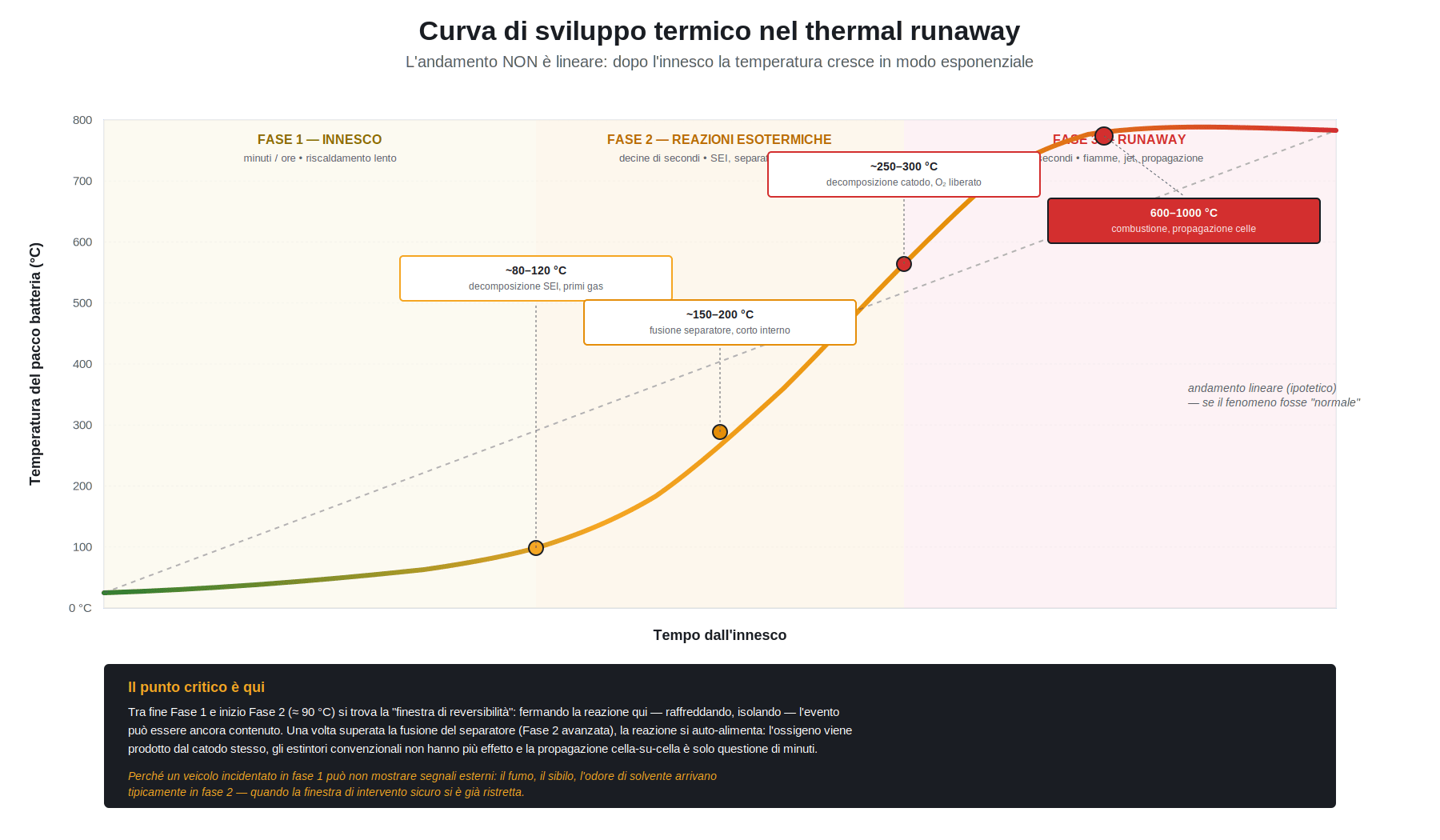
Figure: During thermal runaway, battery pack temperature does not rise linearly. The windows for safe intervention are in the early stages — when there are often no obvious external signals yet.
The common thread of errors is almost always the same: assuming instead of measuring. The leap of professional maturity occurs when the technician replaces the phrase “should be fine” with a numerical value read by the instrument and signed on the checklist. It is the only way to intercept a problem while it is still in the green zone of the curve — and not when the first hiss from the underbody announces it in the red zone.
What is the minimum equipment kit a workshop should have to work safely on EVs?
The “minimum kit” is not an opinion: it is the combination of PPE, collective equipment and measuring instrumentation which, if even a single item is missing, makes it impossible to certify that the vehicle has been made safe. We summarize it below in three categories, ordered by purchase priority.
| Category | What you need | Reference |
|---|---|---|
| PPE | Class 0 dielectric gloves (1000 V) with mechanical overgloves, tested every 6 months; insulating visor/goggles; dielectric helmet; antistatic/insulating footwear; low-conductivity, flame-resistant clothing (with arc-flash protection also referred to in CEI 78-24). | EN 60903 / EN 50365 / IEC 61482 |
| Collective equipment | 1000 V insulating mat; insulated tool sets (wrenches, screwdrivers, pliers); “Electrical work in progress” signs and mobile barriers; LOTO kit (padlocks, tags, service key cases); fire extinguisher for electrical fires; EV fire blanket. | IEC 60900 / DIN SPEC 91489 |
| Basic Measurement | CAT III/IV 1000 V multimeter certified for DC measurements on traction systems; safety test leads with caps; high-voltage DC clamp meter. | IEC 61010-031 |
The important detail: the equipment must be checked periodically. Dielectric gloves, in particular, must be tested every six months (dielectric withstand test), and each use requires a visual inspection and the “rolling test” — inflating the glove and looking for leaks. A glove that has been sitting in a cabinet for two years, never tested, is a glove to be thrown away.
The second important detail: the “EV fire blanket” is a new item compared to the standard workshop firefighting kit. Blankets compliant with DIN SPEC 91489 are designed to contain — not extinguish — a thermal runaway, buying time until the Fire Brigade arrives. On a lithium pack, a powder extinguisher looks impressive but is of little use.
In addition to the minimum kit, what advanced measuring instruments are indispensable today to certify that the vehicle is really safe?
The basic kit allows you to work; it does not allow you to certify. To responsibly declare that a vehicle is electrically safe — before disassembling a component, before resuming work after an accident — you need more sophisticated instrumentation. This is where many workshops stop, and where the difference between a rough repair and a technically traceable and repeatable repair becomes apparent. Traceable means that each measurement is recorded, dated and traceable to the instrument and the operator; repeatable means that, repeated after some time or by another PES, it returns the same result. These are the two requirements that underpin any serious technical certification, and in the electric world they are not optional.
THE RIGHT CERTIFICATION INSTRUMENTS FOR WORKING ON ELECTRIC AND HYBRID CARS
- Insulation tester (Megger) up to 5 kV: measures the insulation resistance between HV+/HV− and chassis. The expected value is in the order of megohms (typically tens, on a healthy battery pack); a low value is the first, and sometimes only, indicator of an incipient insulation loss;
- 4-wire milliohmmeter / micro-ohmmeter: used to verify earth continuity, chassis equipotential bonding and the integrity of power connections. The expected resistances are in the order of milliohms: values that a standard multimeter cannot measure accurately;
- Dedicated CAT III–IV 1000 V HV voltmeter/multimeter — here is an important point. The measurement of the absence of voltage on a traction system is in DC and must always be performed by contact, at two points, with a certified instrument. It is worth clarifying that common “non-contact” voltage detectors (NCVs) marketed for domestic installations are not suitable: they detect the electromagnetic field generated by alternating current, while the HV system of an electric vehicle is DC and does not generate the same field. On an orange cable, an NCV may give no indication even when the system is live. The check must be done with an instrument, by contact;
- Oscilloscope with isolated probes and CAN HV diagnostics: essential for analyzing BMS (Battery Management System) communication, identifying anomalies on cell voltage sensors and validating safety circuits;
- Thermal imaging camera: for thermal mapping of the battery pack and to identify cell hot-spots before they escalate into thermal events. It is particularly useful during intake of an accident-damaged vehicle and in post-event monitoring (where an apparently “tamed” pack can smolder for hours or days before reigniting);
- Manufacturer’s proprietary diagnostic tools (ODIS for VW Group, GDS for Hyundai/Kia, Toyota TIS, Tesla Toolbox, etc.): without them, in our experience, it is not possible to read the true status of the BMS or to correctly unlock the service disconnect procedures. They are often tied to annual subscriptions and licenses;
- Dedicated battery pack handling system: HV lifting beams, certified lift tables/trolleys, suitable hoists. A battery pack typically weighs between 300 and 700 kg; handling it by hand or with a pit jack is a shortcut that sooner or later takes its toll.
The “make-safe” sign-off becomes credible only if it is the result of a measured sequence: absence of voltage + insulation + continuity + consistent BMS reading. No single one of these is enough on its own.
What are the most critical phases of an intervention on an electric vehicle?
A well-done HV intervention on electric and hybrid cars is a sequence of five distinct phases: none of the five is optional, and none of the five begins before the previous one has been signed off in writing. Skipping steps, overlapping them or trusting memory are the three easiest ways to turn an ordinary intervention into an accident.
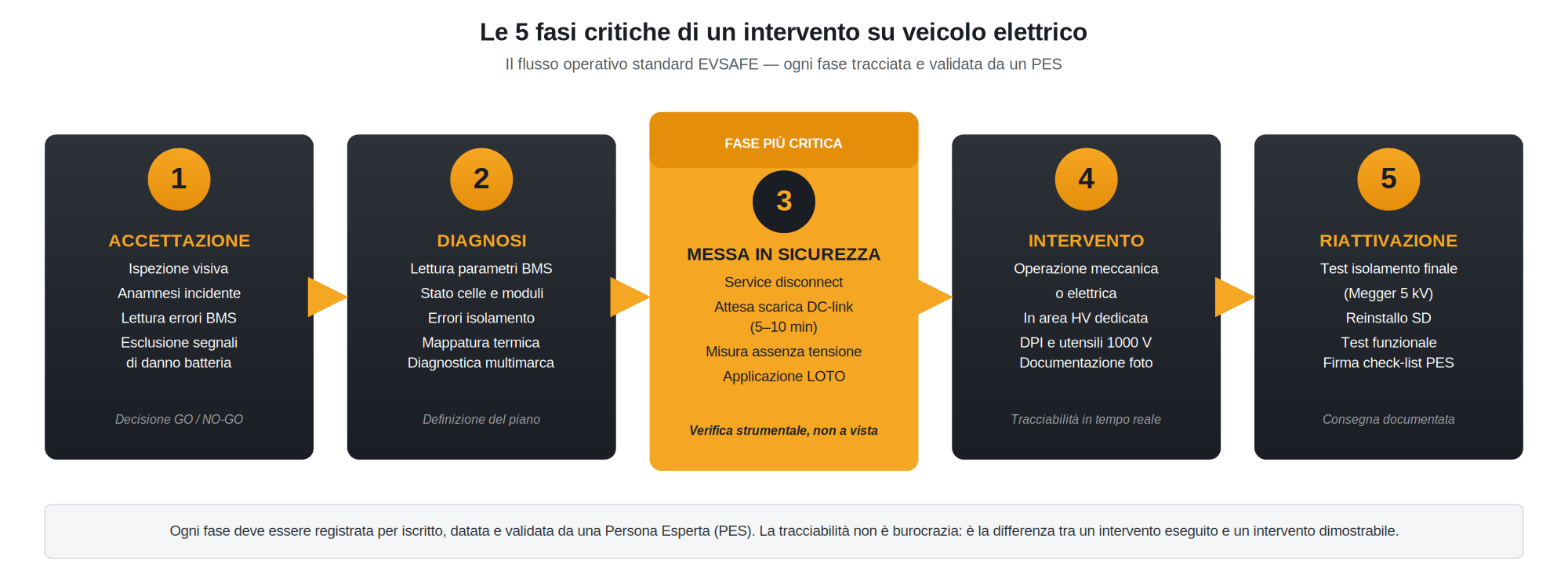
Figure: The five critical phases of an intervention on an electric vehicle. Making the vehicle safe is the most delicate step in the entire sequence.
- Vehicle intake and preliminary assessment
It starts before the vehicle enters the workshop. 360° visual inspection, checking for external signs of battery damage (deformation, leaks, odors), preliminary reading of BMS errors, gathering the vehicle’s history: does the customer report a collision? An abnormal charging event? Exposure to water? This information radically changes the level of risk;
- Diagnosis
Instrumental reading of the vehicle status: BMS parameters, state of charge and “health” of the cells, insulation errors, recent temperatures, charge/discharge cycles. This is the phase in which you decide what to do and what cannot be done in the workshop (a visibly compromised battery pack must not be opened: it is placed in a container, and the manufacturer or an authorized center such as EVSAFE is called in);
- Making Safe / HV Isolation
The most critical phase of the sequence. The service disconnect is removed, the DC-link discharge time specified by the manufacturer is observed (typically 5–10 minutes, but some vehicles require more), the absence of voltage is measured with a certified instrument, the LOTO is applied, the checklist is signed. Only at this point is the vehicle formally “safe” — not a second before;
- Intervention
Mechanical or electrical work in the dedicated area, with full PPE, insulated tools and — when required — a second PES operator present. Every removal and reassembly of HV components is recorded;
- Reactivation and validation
This is the most underestimated phase, and it is the one that closes the circle. Post-intervention insulation check (Megger test), reinstallation of the service disconnect, functional test of the vehicle, final diagnostic reading, signing of the closure checklist. Without this phase, the vehicle goes back to the customer with an unresolved unknown, and with it, liability falls back on the workshop.
Each phase produces a document: “making safe” without traceability, in the event of an accident or litigation, counts as if it had never been done.
Which steps are most often skipped or performed incorrectly?
The shortcuts are always the same, and it is important to call them by name. Knowing them helps both the technician — to recognize when he is giving in to haste — and the technical manager, to put targeted checks in place in the areas at greatest risk of omission.
The five most common shortcuts
- Judging the DC-link discharge wait time “by eye”. This is the king of shortcuts. Five minutes of waiting becomes two, two minutes become “the time to go and get the instrument”. Capacitors, however, don’t check the workshop clock;
- Absence-of-voltage test omitted because “the system is in service mode”. This is the most common and most dangerous error: service mode is not a verified physical state, it is merely a software output;
- Post-intervention insulation check skipped because “the car starts”. The fact that the vehicle starts does not prove that the insulation is intact: it only shows that the BMS has not yet detected the problem;
- No LOTO in small workshops. “We all know each other” is not a safety procedure. LOTO does not protect against colleagues: it protects against reflex actions (a customer who returns to the workshop, an apprentice who wants to “try”);
- Neglected photo/paper records. This is the shortcut whose cost comes due later: in the event of a dispute, the only defense is the documentary traceability of the intervention.
All these shortcuts have one thing in common: they silently increase risk, and almost never have an immediate effect. That’s exactly why they’re dangerous: those who have done them a hundred times without consequences tend to consider them part of normal work, until the day the consequences come. HV safety is a field where experience, alone, is a bad teacher.
How should a workshop and work area be physically organized to safely handle these vehicles?
A good EV workshop does not stand out for the amount of technology: it is distinguished by the layout. The physical separation of activities is the first, and cheapest, level of safety. Redesigning the workflow is worth more than many equipment purchases.
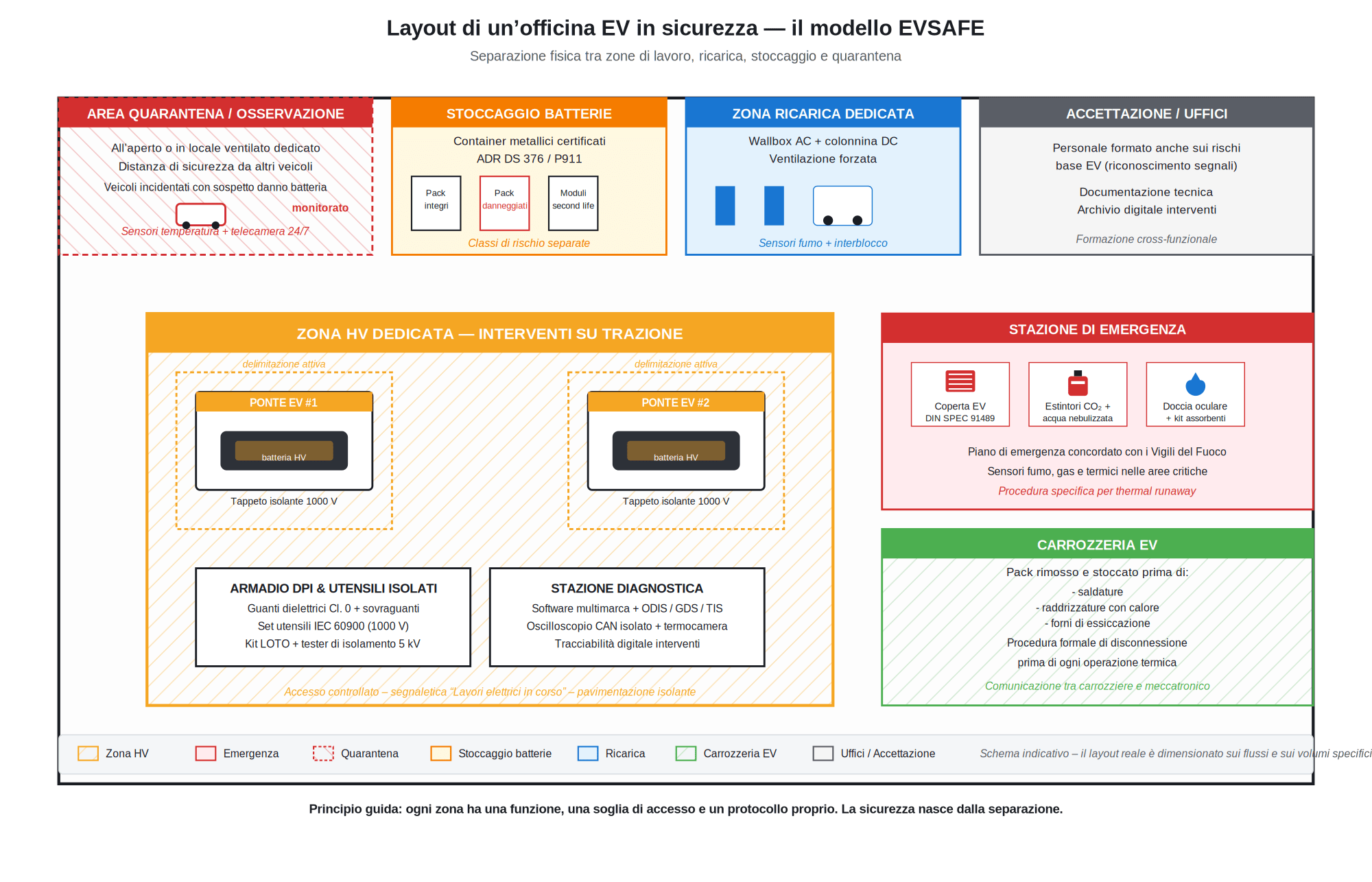
Figure: Reference layout of a workshop equipped for electric vehicles. The aim is to clearly separate the intervention area, charging area, battery storage area and quarantine area.
THE ESSENTIAL AREAS
- Dedicated HV zone: one or more lifts (or ground areas) reserved for work on traction systems, with insulating flooring, adequate lighting and controlled access. Ideally located along the perimeter to allow rapid evacuation of the vehicle in case of emergency;
- Deployable physical barriers (chains, retractable posts, mobile barriers) around the HV area during the job. It is not a frill: it prevents anyone — colleague, customer, supplier — from coming within reach of an exposed orange cable;
- Battery storage area separated from the intervention area and the charging area, with metal containers certified for lithium. A separation is maintained between intact batteries, “healthy” used batteries and suspect/damaged batteries, each with its own risk class;
- Quarantine/observation area outdoors or in a covered, ventilated area, reserved for accident-damaged vehicles with suspected battery damage. The safety distance from other vehicles and sensitive structures is typically 10–15 meters (international good practices, e.g. NFPA, indicate values in this range);
- Adequate ventilation: the venting gases of a lithium battery are flammable and explosive. The HV zone and the storage zone must ensure sufficient air exchange and, ideally, an outlet to the outside;
- Smoke, gas and temperature detection systems in critical areas. A thermal probe in the storage container costs little and provides minutes of early warning which, in the event of an incident, make all the difference;
- Cabinet for PPE and insulated tools in a single, accessible location, with periodic inspection log. Disorder = delay in emergency;
- Emergency station with EV fire blanket (DIN SPEC 91489), suitable fire extinguishers, electrolyte absorbent kits, eyewash station and a direct line to the Fire Brigade. It must be tested, not just set up;
The investment needed to reorganize an HV area in an already active workshop is almost always much lower than you think: in most cases it is a matter of remapping flows and installing a few mobile barriers, not of rebuilding the building. The real prerequisite is the decision to do so.
What are the warning signs of a possible chemical fire on an accident-damaged electric vehicle?
This is perhaps the most important section of the in-depth study we are building here for SICURAUTO.it, especially for those who work in body shops, roadside assistance or vehicle intake. An accident-damaged electric vehicle can appear perfectly intact on the outside and yet harbor, in the battery pack, a slowly progressing thermal event. Recognizing the signs in the first few minutes — often before the vehicle enters the workshop — can literally decide the level of severity of the damage.
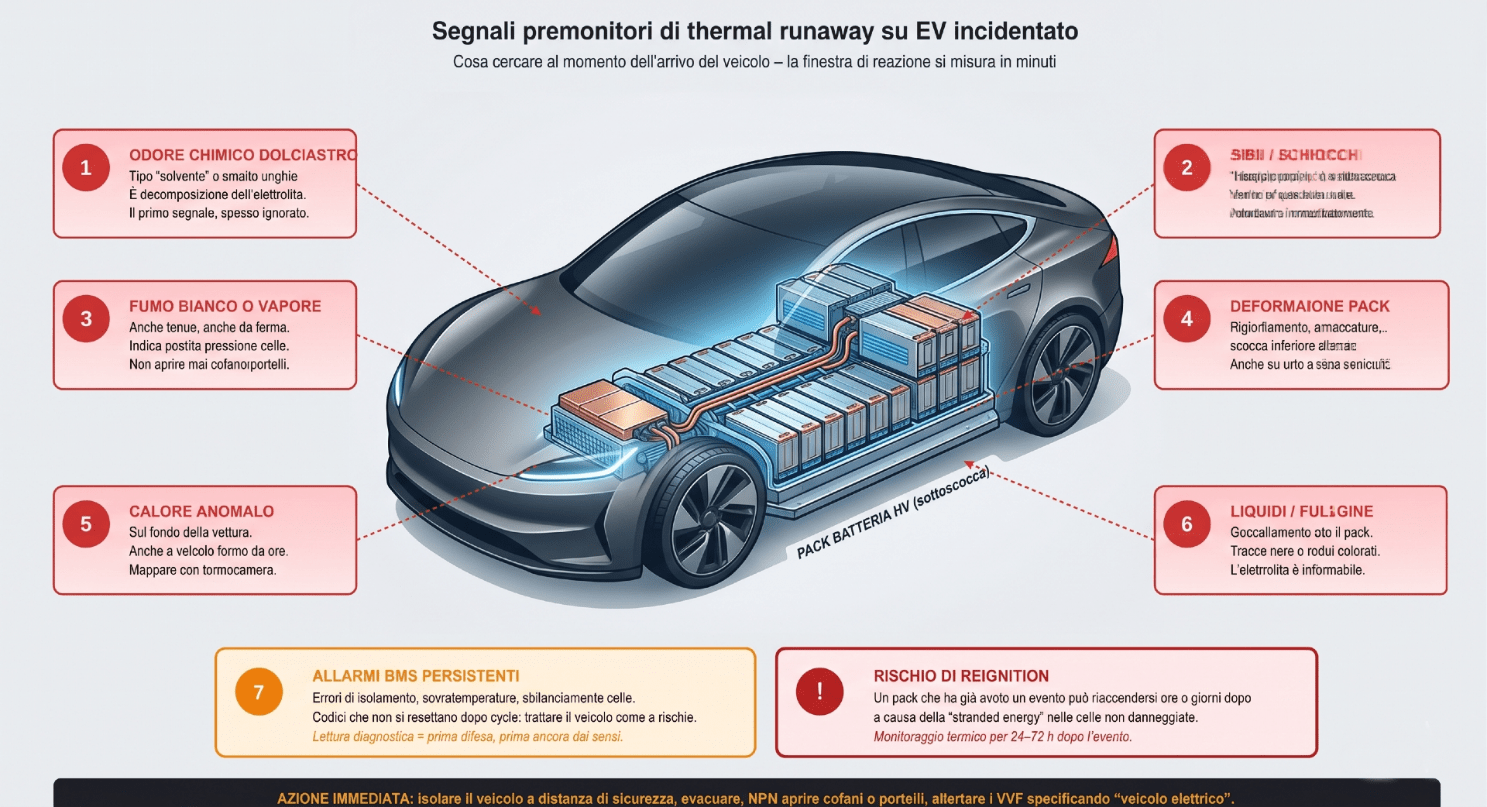
Figure: The six warning signs of a thermal runaway on an accident-damaged electric vehicle. Recognizing even one requires immediate activation of the emergency plan.
SIX SIGNS YOU MUST NOT IGNORE
- Sweetish or pungent chemical odor (reminiscent of nail polish or a light solvent): it is the first indicator of electrolyte decomposition. Noticeable from a distance, even by those who are not technicians;
- Hissing or popping coming from the underbody: this is the sound of gas venting from the cells through the safety valves. It is an unmistakable acoustic signal and — when you hear it — it means that the event is already underway;
- White smoke or even faint vapor from the battery pack or underbody: unlike black oil smoke, lithium smoke is grayish-white and has a characteristic odor;
- Visible deformation of the battery pack or bulging of the underbody: indicates an increase in internal pressure of the battery module — one of the preconditions of thermal runaway;
- Abnormal heat detectable on the underside of the vehicle, even if the car has been stationary for hours. It is useful (and cheap) to get used to passing your hand close to — not over — the underbody, or using a thermal imaging camera;
- Dripping liquids or traces of soot under the battery pack: the electrolyte is an organic, conductive, flammable liquid. Traces under the car are never “normal condensation”.
In addition to these six physical signs, there are the instrument readings read during the acceptance phase: persistent BMS alarms on insulation, temperature or cell imbalance. When even one of the six physical signs is present, or when the BMS reports errors consistent with cell damage, there is only one correct procedure: isolate the vehicle at a safe distance, evacuate the area, do not open hoods or hatches, alert the Fire Brigade, stating explicitly that it is an electric vehicle.
The risk of reignition is real: a battery pack that has already had a thermal event can reignite hours or days later, due to the residual energy retained by the undischarged cells (“stranded energy”). For this reason, post-event monitoring lasts days, not hours.
What are the most serious mistakes that can worsen an emergency situation?
In an emergency, instinct is almost always wrong. The procedures used for combustion vehicles — moving the vehicle under cover, opening the hood to take a look, using a powder fire extinguisher — have the opposite of the desired effect on electric vehicles. These are the mistakes that, honestly, we see or hear about most often, and that EVSAFE training is explicitly designed to dispel.
A LITHIUM FIRE IS NOT A NORMAL FIRE
Before listing the errors, it is necessary to explain why these errors are so dangerous. A lithium battery pack fire does not resemble a conventional fire (as SICURAUTO.it had already pointed out in 2022 in front of the Fire Brigade, ed.), and it is one of the reasons why even experienced personnel can lose their composure the first time they witness one.
The flames come out in jets — horizontal high-pressure jets, similar to those of a blowtorch — directly from the venting valves of the compromised cells, and can reach temperatures of the order of 1,000 °C. The smoke is white, dense and toxic (hydrofluorides, carbon monoxide, hydrofluoric acid, organic vapors), and quickly saturates the closed environment. The noise is loud and discontinuous: prolonged hissing, violent pops due to the rupture of the valves of other cells, occasional explosions with roars. The reaction propagates from cell to cell, sometimes visibly (a pop, a new flame) and sometimes silently, under the sheet metal of the battery box. And above all, the reaction does not end in a few minutes: it can last hours, and can reignite some time later, even after it appears to have been extinguished.
The first practical effect of all this is the risk of panic. Personnel who have dealt with dozens of ICE vehicle fires are faced with a physically different scenario — flames that a fire extinguisher cannot put out, smoke that does not dissipate, noise that does not subside — and tend to react counterproductively: moving closer to “understand”, opening hatches, trying to put it out with whatever is to hand. It is precisely at the moment when the event behaves in a “strange” way that the discipline of the procedure matters more than reactivity. For this reason, at EVSAFE, our drills include the simulation of noise and visual effects: a technician who is emotionally unprepared for the phenomenon is a technician who, statistically, will make the wrong first decision.
THE MISTAKES THAT WORSEN THE EMERGENCY
- Moving the vehicle to a closed workshop before the thermal risk has been ruled out: it means bringing a possible fire indoors, in a building with other vehicles, people and flammable materials. The first gesture, always, is the opposite: move it out, not in.
- Opening the hood or battery hatch “to get a better look”: doing so lets in oxygen, feeds the reaction and directly exposes the operator to gases and ejected material. A thermal runaway is observed — from a distance — not inspected.
- Trying to extinguish with powder or CO₂ fire extinguishers: they are ineffective on thermal runaway, which is a reaction that produces oxygen and heat on its own. Worse: they give a dangerous illusion of control.
- Using a concentrated water jet from above without cooling the battery pack from below. The technique recommended by the Fire Brigade is continuous water misting from the underbody, for hours if necessary. This is not conventional extinguishing: it is prolonged cooling.
- Loading the vehicle onto an enclosed transporter immediately after a thermal event: reignition may occur during transport. Post-event transport should be on an open flatbed, with the vehicle in a containment container or, at least, under thermal monitoring.
- Removing the service disconnect on an already damaged battery pack: it can trigger an electric arc in an already compromised environment. The operating rule is: damaged battery pack = no tampering, storage container, call the manufacturer.
- Declaring a fire “under control” without 24–72 hours of thermal monitoring. International guidelines speak of even longer times for vehicles with large battery packs. Before closing the case, you need the thermal imaging camera.
In an emergency, those who have rehearsed the procedure beforehand come out on top. Having the Fire Brigade’s number in your pocket is not enough: the workshop must have carried out at least one realistic drill.
How much does it realistically cost to retrofit a workshop and how long does it take to recoup the investment?
This is the question that every workshop owner asks himself, and which too often receives vague or, worse, discouraging answers. The truth is that adapting to electric costs less than you think compared to the initial investment to start the workshop, but it requires a recurring expense that many underestimate: training that must be repeated, PPE that must be tested every six months, diagnostic subscriptions that are renewed every year, tools that must be calibrated. It is not a one-off purchase: it is an operating cost.
The orders of magnitude in the graphic below are indicative market figures and vary significantly according to the size of the workshop, the level of service chosen (routine maintenance, intervention on the battery pack, EV bodywork, post-accident) and the brands to be covered. However, these are real figures, taken from the cases our company handles.
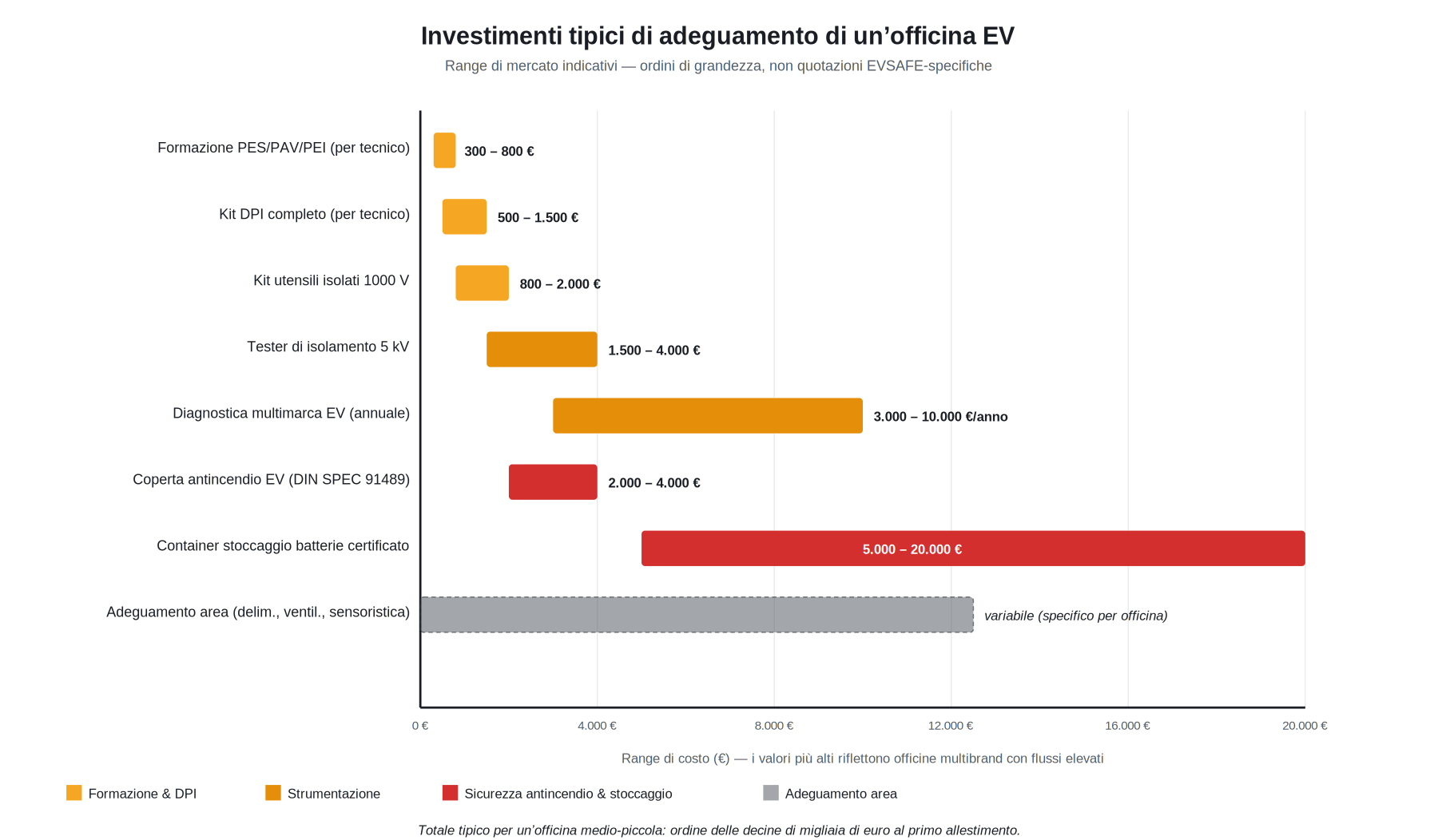
Figure: Indicative investment ranges for retrofitting a workshop to electric vehicles. Amounts in euros.
| Item | Indicative Range |
|---|---|
| PES/PAV/PEI training for technician (with EV specialization) | 300 – 800 € |
| Complete PPE kit for technician (gloves, helmet, visor, footwear, clothing) | 500 – 1.500 € |
| IEC 60900 certified 1000 V insulated tool kits | 800 – 2.000 € |
| 5 kV insulation tester (Megger or equivalent) | 1.500 – 4.000 € |
| Multi-brand EV diagnostics + annual subscriptions | 3.000 – 10.000 €/year |
| EV Fire Blanket (DIN SPEC 91489) | 2.000 – 4.000 € |
| Certified metal container for battery storage | 5.000 – 20.000 € |
| Work area upgrade (barriers, ventilation, sensors) | Variable |
| Premises upgrade for a higher fire risk category | Variable (important) |
AN OFTEN FORGOTTEN ITEM: FIRE SAFETY UPGRADES
The most neglected — and potentially the most expensive — point concerns the adaptation of the premises to the new fire risk categories. The presence of lithium battery packs (both on vehicles and in storage) may lead to the reclassification of the business into a higher fire risk category or, in some configurations, to its inclusion among the activities subject to Fire Brigade inspection. The practical consequences can be significant: overhaul of the electrical system (fire resistance, dedicated isolating switches), review of furnishings and materials on the premises, separation between the intervention/storage area and areas open to the public (reception, waiting room), fire doors, adequate detection and compartmentalization systems. This is a matter that requires a specific inspection and discussion with a qualified fire technician and with the local Fire Brigade; the cost varies greatly depending on the starting state of the building.
Adding up the basic items, the first implementation investment for a small-to-medium-sized workshop is typically in the order of tens of thousands of euros, with a recurring component for instrument maintenance, periodic verification of PPE and training updates weighing in at a few thousand euros per year. Any fire safety adaptation, when necessary, must be evaluated separately and may be the dominant item if the building is not already compliant.
AND THE RETURN ON INVESTMENT?
The payback time depends on the mix of services and the local EV market. Our direct experience — supported by the cases of partner workshops — indicates that the items that generate margins most quickly are three: HV diagnostics with a specialized hourly rate (higher than the ordinary rate, as we had already discovered in this 2023 interview, ed.), post-claim repairs for insurance companies (which need certifiable centers and accept appropriate labor rates) and training/coaching for other workshops. The margin on these activities is significantly higher than that of traditional mechanics.
In summary: the investment is sustainable, the real risk is not financial but one of timing. Those who equip themselves now intercept a growing demand; those who postpone risk finding themselves competing in 2028 on a market where EV specialization is no longer a differentiator, but a basic requirement. For a detailed case-by-case analysis, EVSAFE offers a dedicated assessment service covering workflows, upgrade requirements — including fire prevention — and on the expected break-even.
Where does the need to create a company like EVSAFE come from?
EVSAFE was born from observing an obvious gap. The electric transition is bringing vehicles to the workshop — more and more every year — on which the traditional supply chain is not structurally equipped to operate safely. At the same time, upstream and downstream of the technical intervention, there is a lack of a complete ecosystem (independent HV diagnosis, repair of battery packs, second-life reuse, warranties, insurance appraisals, marketplace of certified components) that makes the used electric car credible as a market product. Without this ecosystem, the residual value of the electric vehicle collapses and with it the economic sustainability of the transition.
The project is the result of a partnership between A21 Holding, a group rooted in the automotive and repair world, and Privé Srl, an Italian engineering and consulting company specializing in electric vehicles. The headquarters and the first operational center are in Paderno Dugnano, a few kilometers from Milan: an area chosen not by chance, because it brings together Italy’s highest concentration of EV registrations and a network of workshops, fleets and insurers looking for a local technical point of reference.
FOUR AREAS OF ACTIVITY
- Specialized technical service: maintenance, repair and post-accident management on electric and hybrid vehicles of all brands. Own workshop in Paderno Dugnano;
- Training for workshops, fleets, insurers and roadside assistance providers: courses ranging from essential PES/PAV/PEI training specifically tailored to electric vehicles, to advanced operational courses involving hands-on work on the vehicle and battery pack, with practical exercises on real vehicles;
- EV engineering specialized in management software and batteries: advanced diagnosis of battery packs, technical appraisals for insurance companies, third-party opinions on damaged vehicles, reverse engineering when the manufacturer’s data is not available;
- Marketplace of certified components and accessories where you can find new and used spare parts with traceability and warranty, a solution to the problem of OEM procurement times and the risk of unverified components.
The declared ambition is to replicate the model at national level by 2030, building a network of centers of excellence that share technical standards, procedures and safety culture. It is not a commercial goal for its own sake: in our opinion, without a network of equipped workshops, the electric transition remains a laboratory experiment.