 Automobilista e riparatore auto
More Mileage, More Data and Services: How the Relationship Between Motorists and the Aftermarket Is Changing
The car remains at the heart of Italians' mobility, but how it is used, drivers' willingness to share vehicle data and the evolution of the repair network are redefining the balance of the aftermarket. GIPA analyses the main changes under way and the trends that will shape the market
The car remains at the heart of Italians' mobility, but how it is used, drivers' willingness to share vehicle data and the evolution of the repair network are redefining the balance of the aftermarket. GIPA analyses the main changes under way and the trends that will shape the market
Technological innovation and new European regulations are reshaping the future of the automotive industry. Topics such as the Data Act, access to vehicle data, predictive maintenance, artificial intelligence and digitalisation of services are some of the main areas of analysis in the 6th Aftermarket Report, because they are destined to profoundly transform the way in which the entire supply chain will develop products, services and customer relationships. However, every innovation produces value only if it meets the needs and earns the trust of those who use the car every day. Understanding how mobility habits, vehicle use, the propensity to share data and drivers’ expectations of the service network are changing therefore means interpreting one of the most decisive factors for the future of the aftermarket.
This is why we asked GIPA, a research company specialising in the automotive and aftermarket sectors, to share some of the most significant findings from its observatory. The analyses that follow offer a complementary perspective to the insights in the Report, helping to link the major technological and regulatory changes with the real behaviour of Italian motorists. They provide an essential key to understanding how the demand for services, the relationship of trust between customer and repairer and, more generally, the competitive balance of the aftermarket will evolve in the coming years.
📊
This content is part of SICURAUTO.it’s 6th Aftermarket Report, titled: “The Aftermarket in the Era of European Regulations: Opportunities, Constraints and New Specializations”.
How has motorists’ behaviour towards their cars changed in recent years?
In a nutshell, we could answer this question, which everyone has been asking for some time, in a single sentence: the car’s central role is increasingly undisputed, despite growing competition from all the new forms of mobility. Our observatory confirms that the travel habits of Italian motorists changed many years ago, after which everything gradually settled down and remained stable for many years. The pandemic, which prevented us from travelling for weeks and months on end, caused some small declines, followed by a rapid rebound that brought us back to pre-COVID averages.
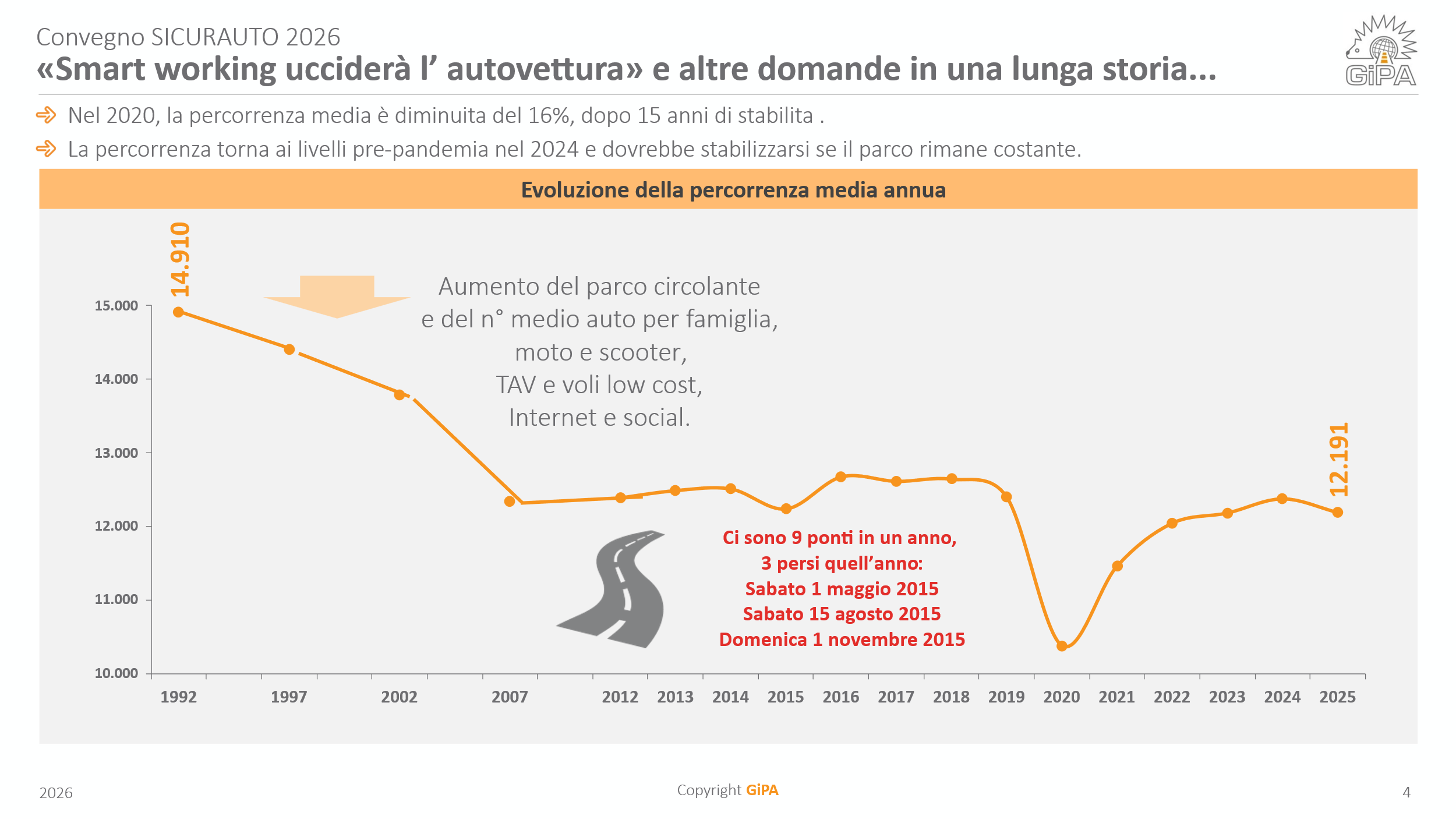
Back in 1992 the average Italian drove about 15,000 km a year; by 2007 the bulk of the transformation had already taken place, with mileage dropping sharply to less than 13,000 km a year for a host of reasons:
- Growth of the car parc and the inevitable reduction in average mileage per car
- Arrival of high-speed rail (TAV) and low-cost flights
- Advent of the Internet and social media (fewer and fewer face-to-face meetings and many more video calls)
- Rise of motorcycles and scooters
Watch out for this cross-sector competition from two-wheelers, which persists to this day, driven by:
- Desire to save money on purchase, maintenance and insurance costs…
- Traffic chaos and parking problems
- Favourable climate in recent years
The increase in average mileage is also a favourable element for the aftermarket, as it leads to greater consumption of spare parts, tyres and wear parts.
We are witnessing an increase in the share of drivers who use alternative modes of transport alongside the car: from 49% in 2022 to 54% in 2025.
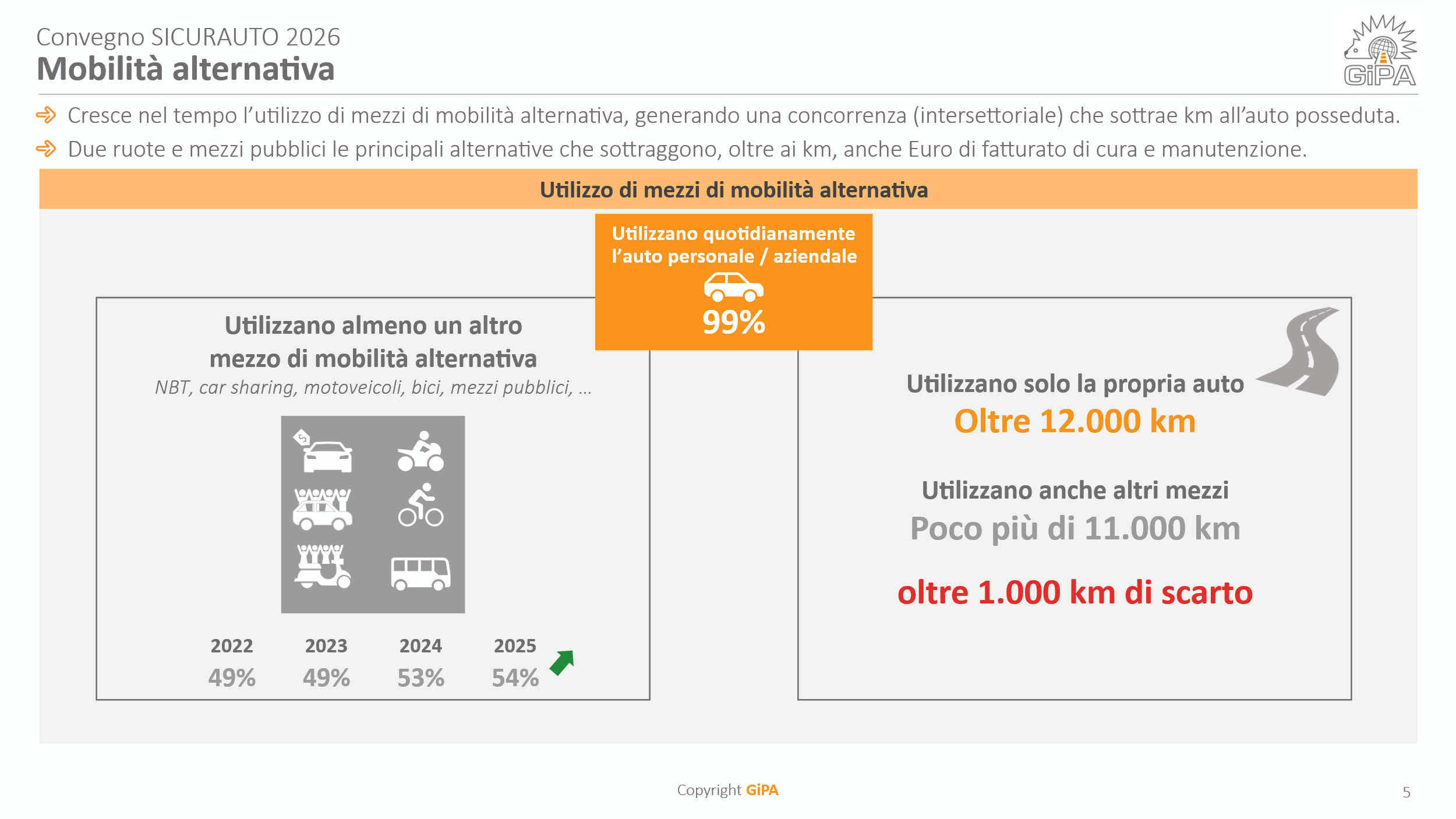
However, the share of Italians who also use their personal/company car on a daily basis during the year is again confirmed at 99%. The 46% of Italian motorists who use only their own car drive over 12,000 km, while drivers who combine their car with other means of transport cover around 11,000 km.
The gap between the two groups is just 1,000 km per year, confirming that everyone relies on their car, which is vital in some regions of Italy for being on time and planning the countless activities that make up a typical day. Indeed, we should not forget that the average Italian uses their car for a wide range of reasons, as shown in the following chart.
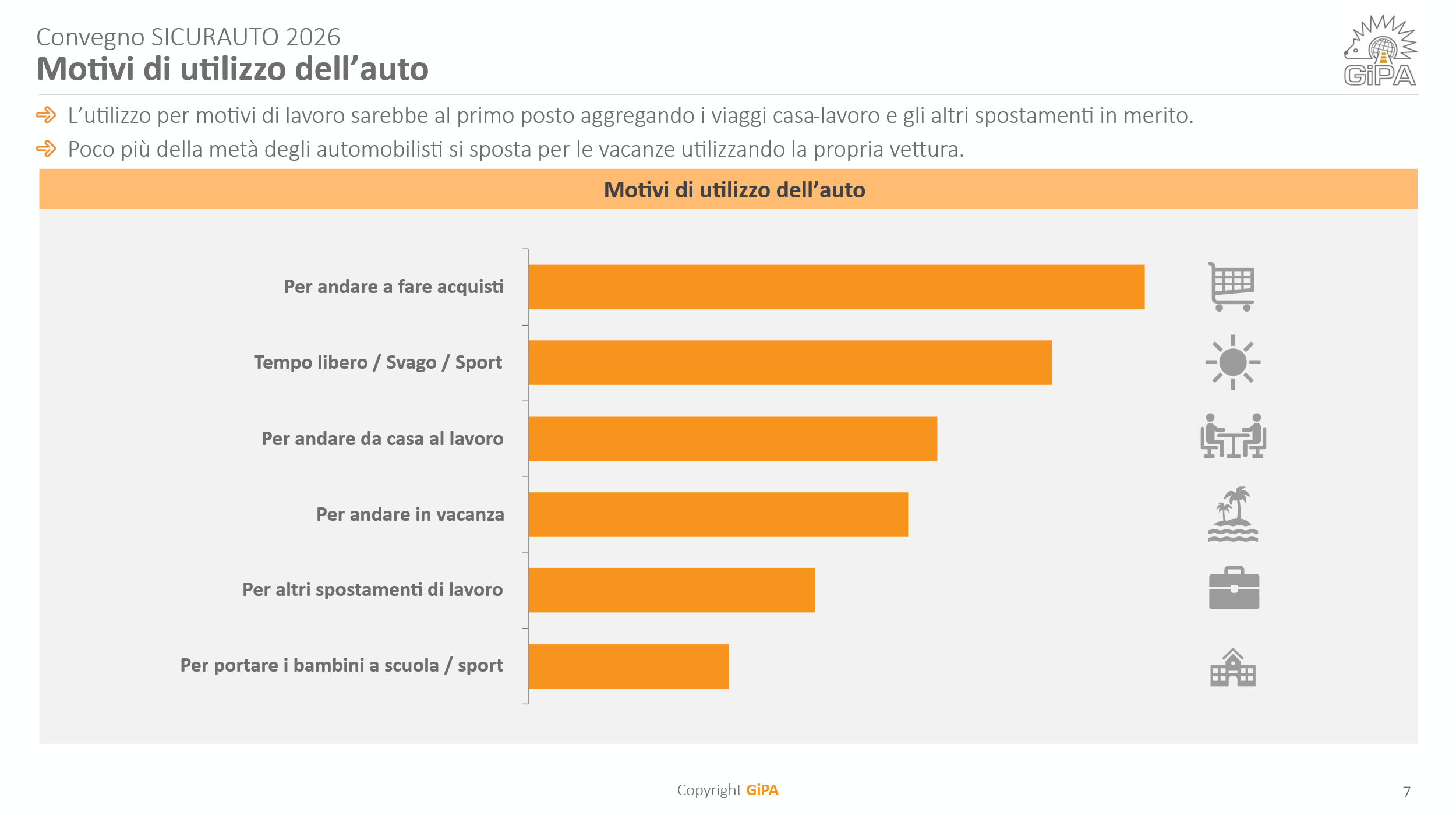
Contrary to expectations, the top spots are not taken by work-related trips, which only come third, but by shopping and weekends/leisure. In fourth place comes going on holiday, which has become highly relevant again due to the search for social distancing and the desire to be free from the fear of flight cancellations during the pandemic and the dreaded post-return swab test. In last place overall, but gaining significant ground among 30-50-year-olds, comes taking children to school, sports, theatre, music and the countless other activities our children are now involved in.
Even when, as this year, a small share of the population reports having driven slightly fewer km than last year (12%), there is always an almost equal share (10%) that offsets the drop by driving more.
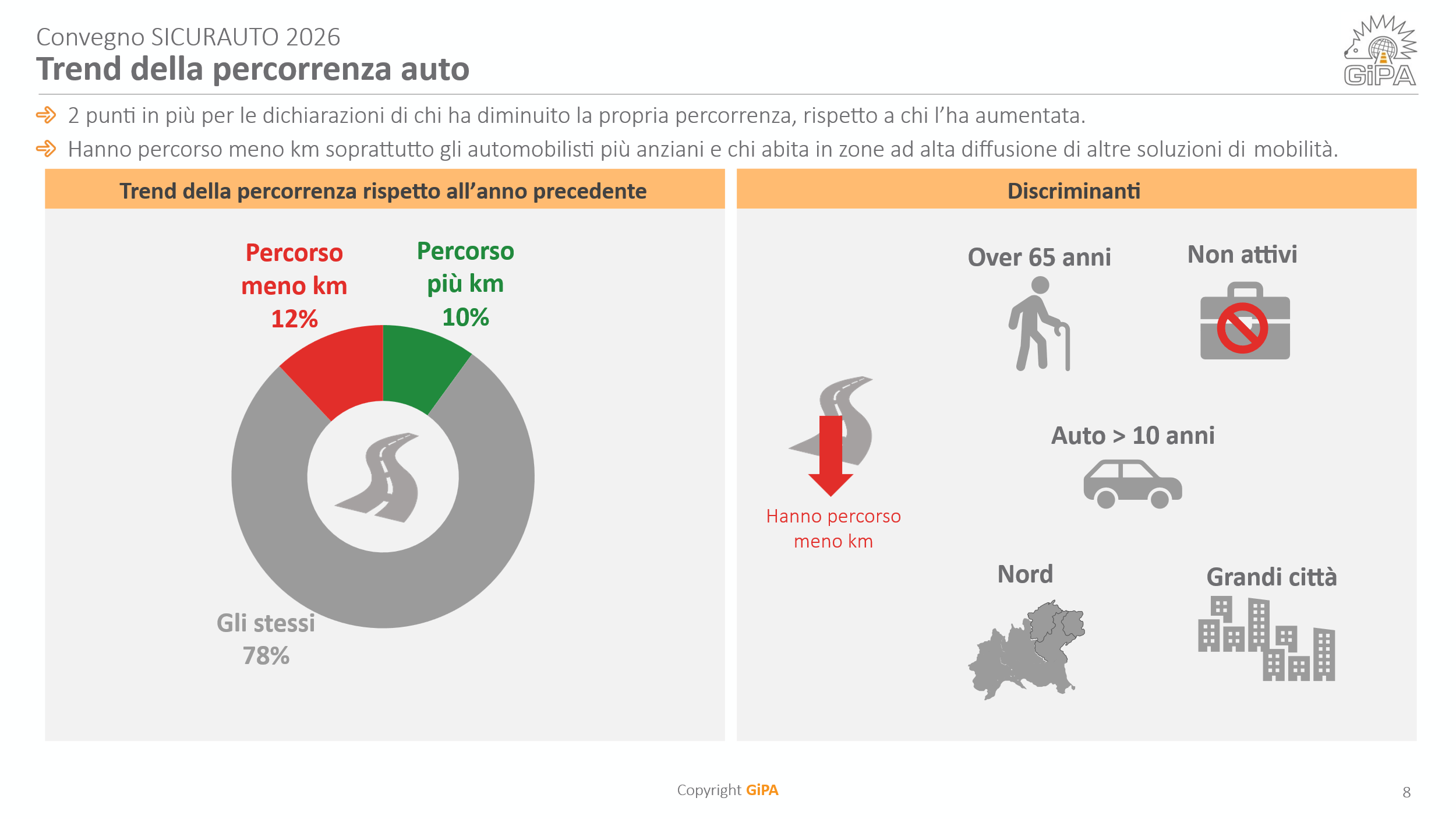
Over the last 12 months, those who used their cars slightly less were mainly older people, the economically inactive (quite possibly pensioners), owners of cars over 10 years old, and those living in large cities (only six in Italy: Rome, Milan, Naples, Turin, Palermo and Genoa), especially in the North, who can rely on several metro lines, frequent trams and buses, and car sharing. In all other towns and cities, using the car to reach the coach stop, bus station or train station is vital.
If we stop to understand the reasons behind this drop in mileage, however slight, we see that:
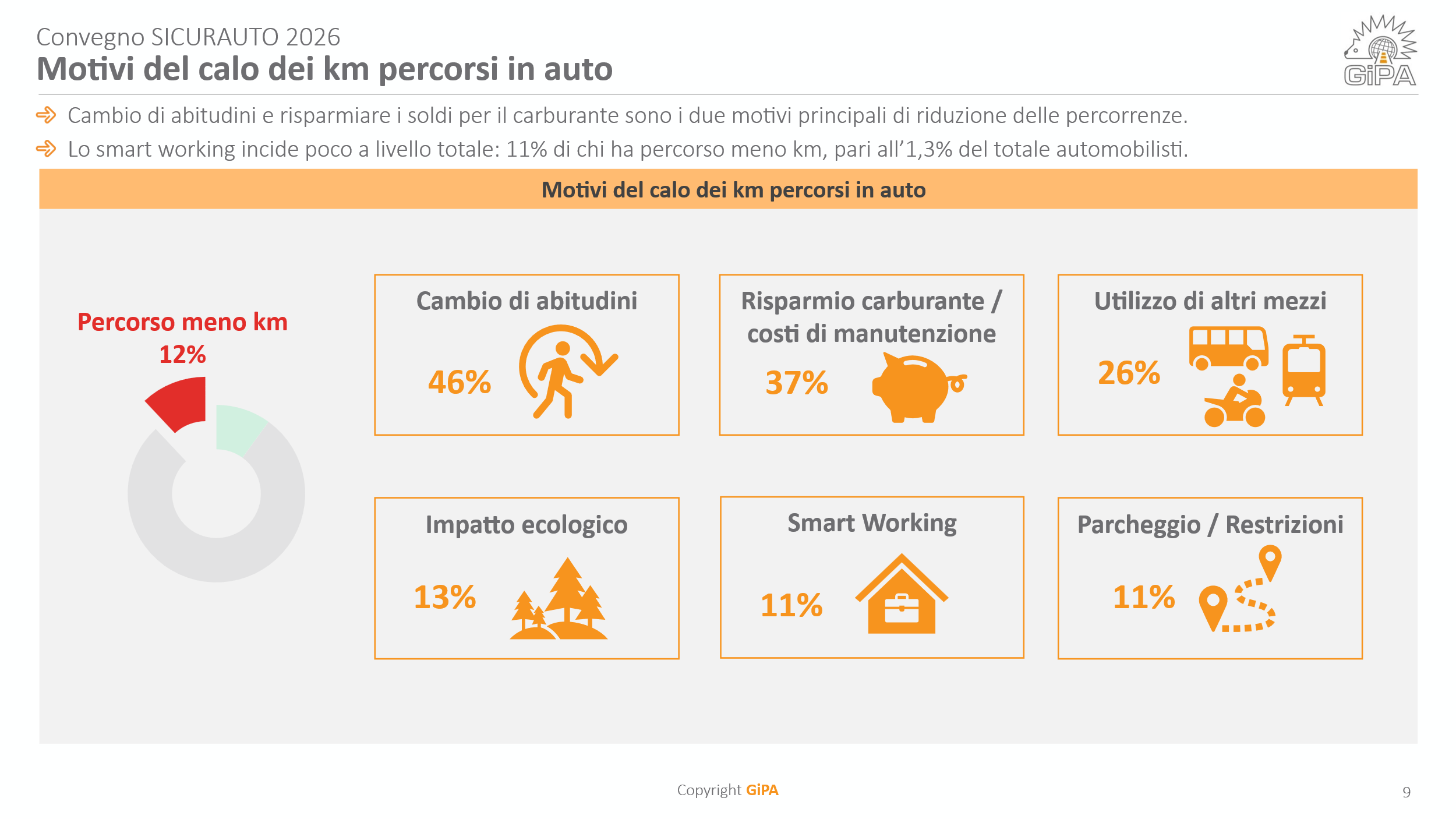
In first place is a change in habits: a new job, home or city that allows people to use the car less. Close behind are reasons related to savings, both direct, such as fuel or care and maintenance costs, and indirect, such as switching back to public transport or a two-wheeler. Then comes the environmental aspect, followed by issues such as city traffic restrictions and parking difficulties. Finally, clear proof of the limited impact of smart working: working more from home ranks near the bottom.
When we investigate how those who drove fewer km by car made their journeys instead, we discover that:
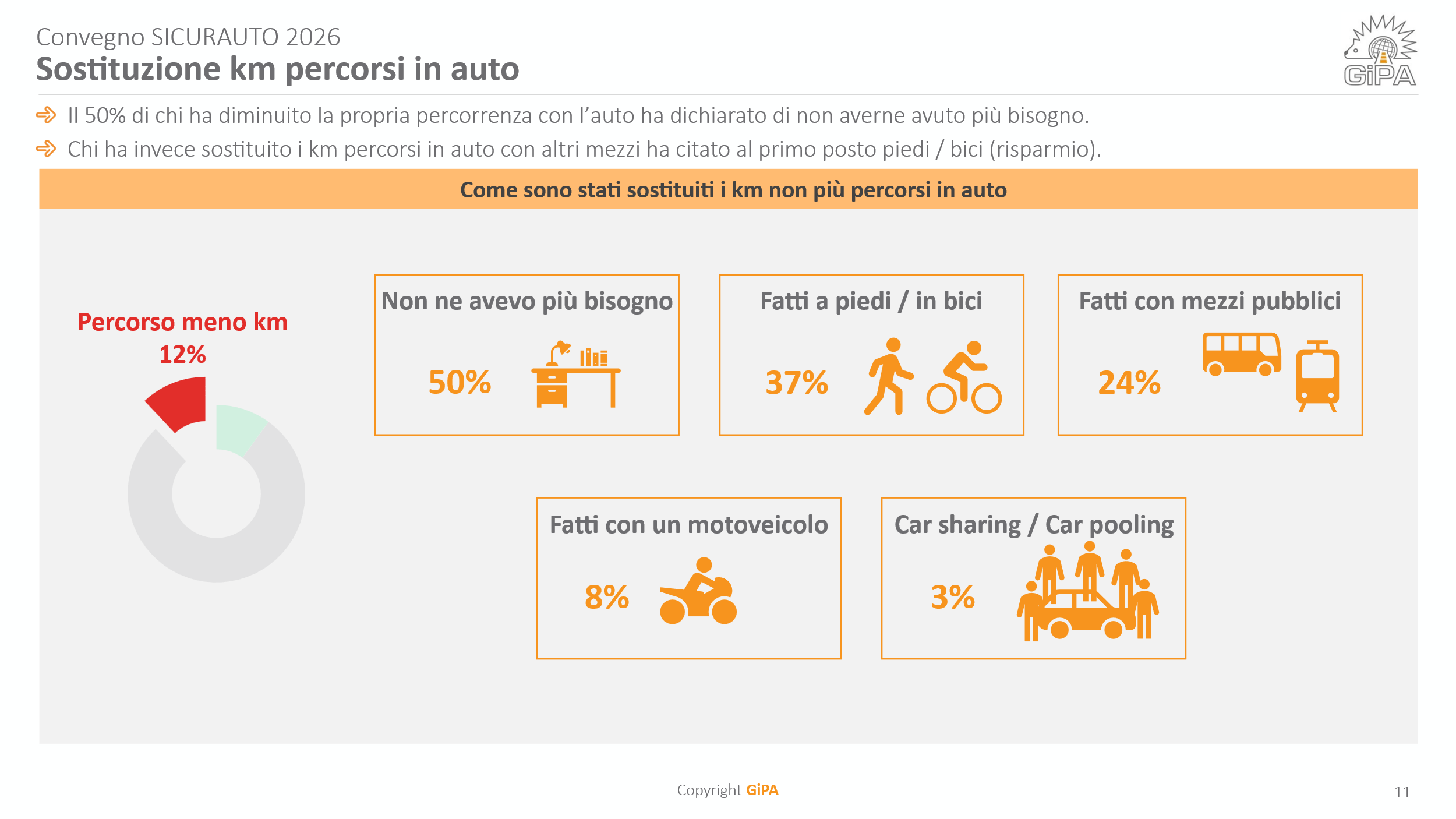
Half did not replace these journeys with any other means of transport because they no longer needed to make them. Those who did switch did so mainly to save money: walking or cycling more or planning their routes more efficiently, or turning to carpooling. Again in terms of indirect savings, others make greater use of public transport or motorcycles/scooters. Very few resort to car sharing.
This explains why, for us at GIPA, the car’s central role is a certainty and an increasingly topical issue.
How willing are Italian motorists to share their car data with their trusted repairer?
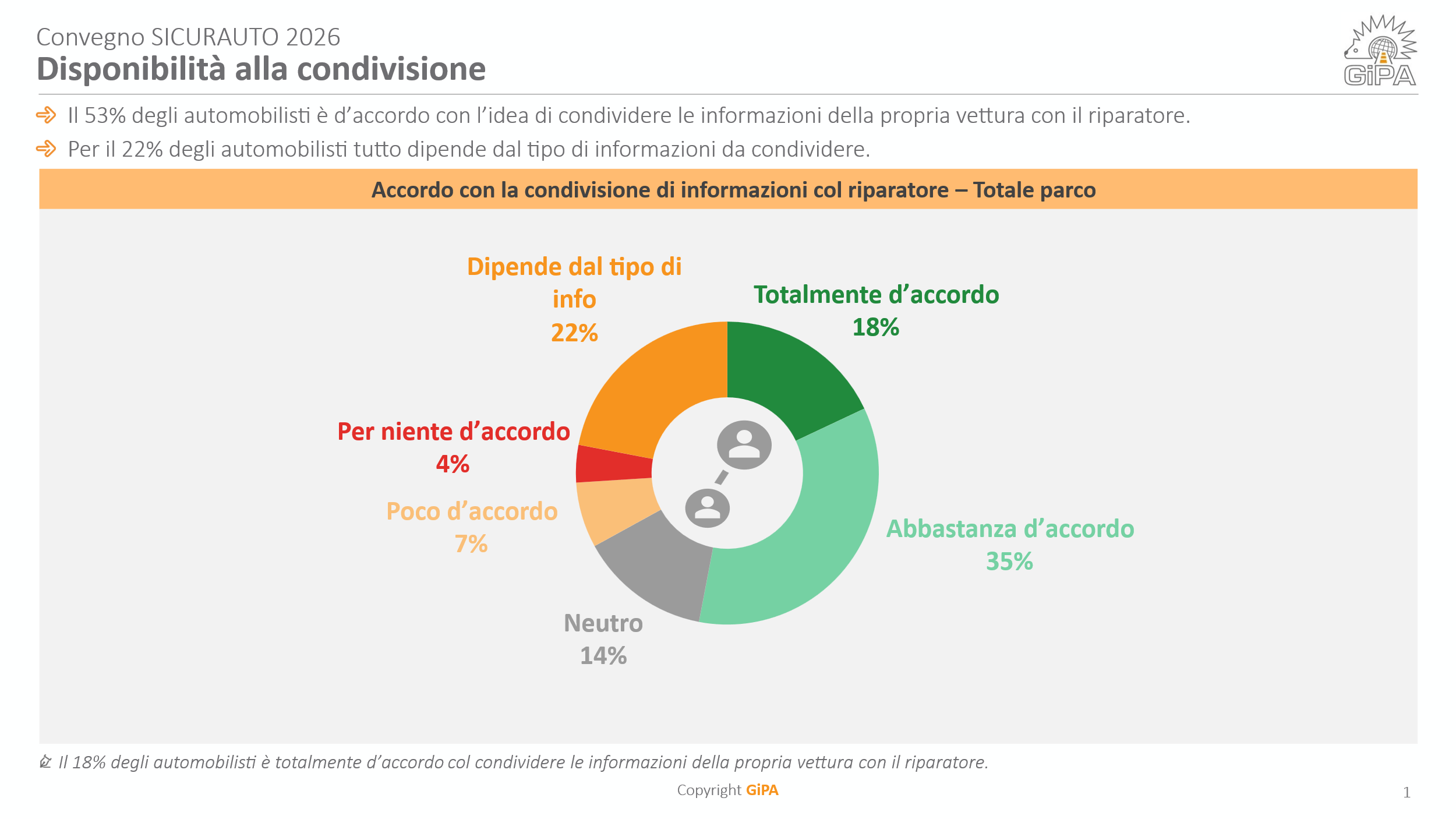
To put it in a nutshell, the answer could be summed up as: very little, and it depends on the type of information (22%). Only 2 in 10 say they fully agree, while 1 in 3 remains fairly cautious. 1 in 10 is indifferent, while 11% is fairly opposed.
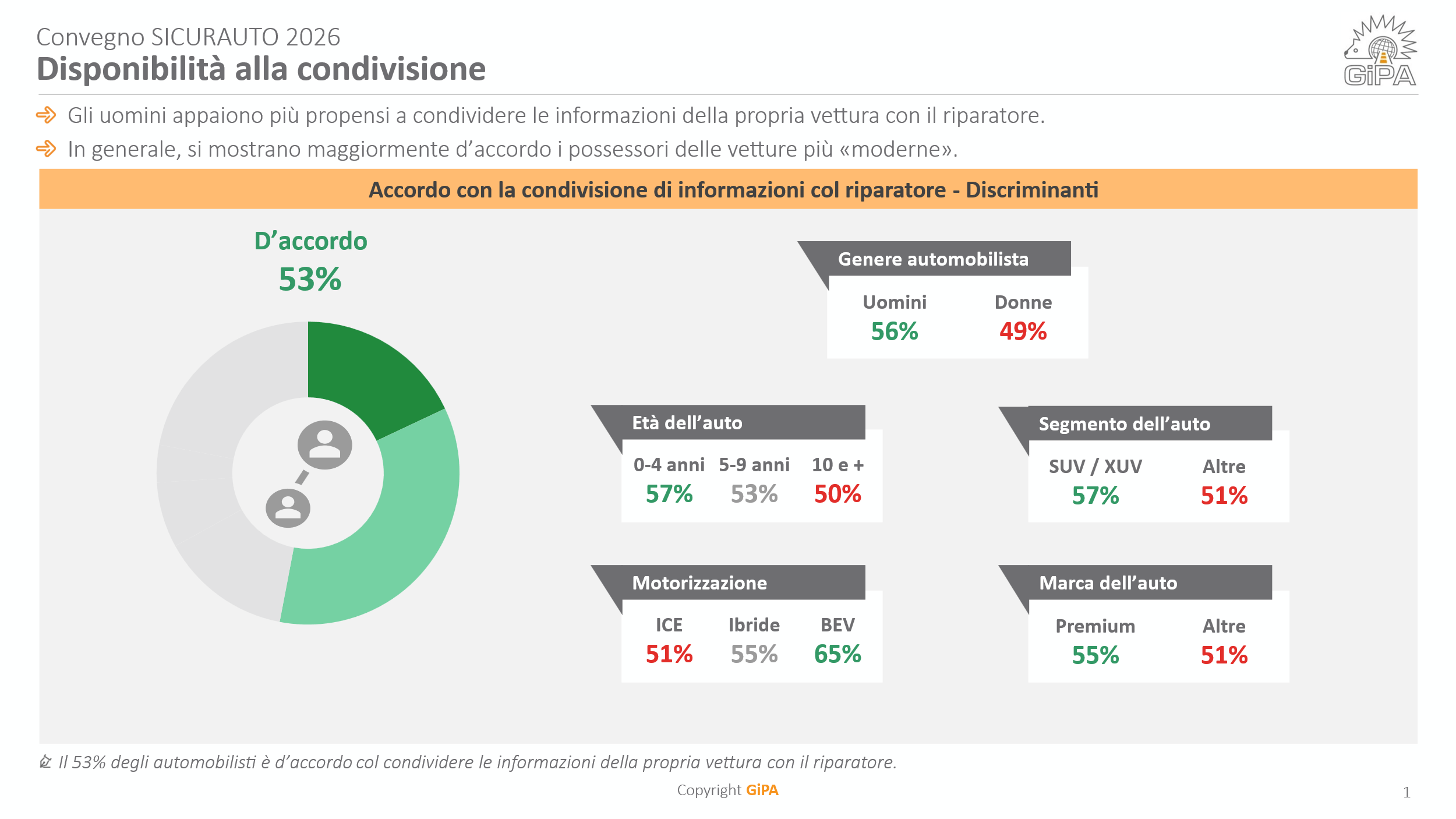
If we consider the less sceptical and therefore focus on the half who fully or fairly agree, we see that men are more favourable than women and young people have fewer reservations than older ones. Owners of SUVs/XUVs, premium cars or electric cars seem the most willing.
But what information would they be willing to share? There is certainly less reluctance to share information on the condition of the car:
- Maintenance due
- The car’s health status in real time
- Km on the odometer
- Any faults or breakdowns of the vehicle.
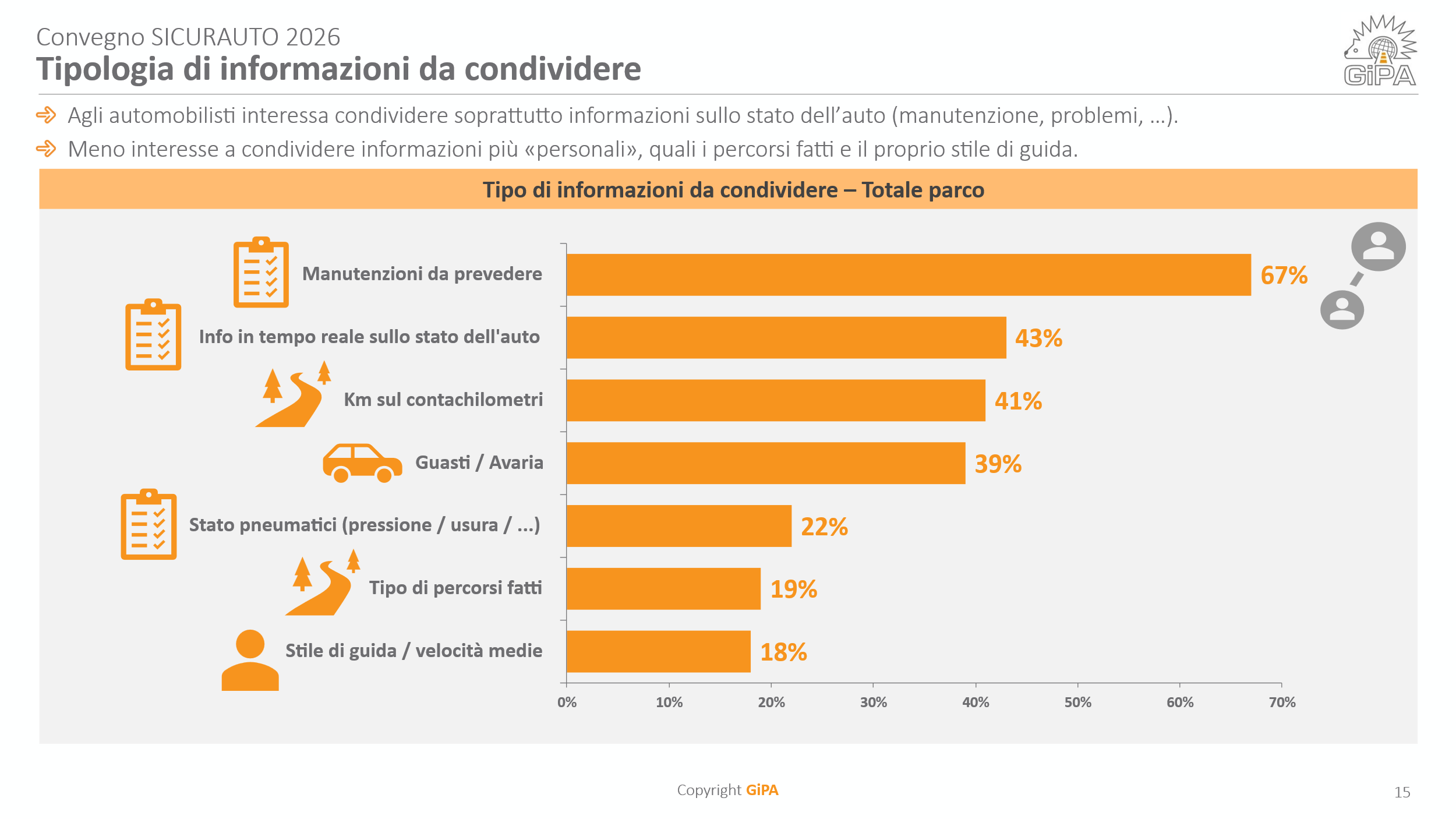
There is slightly less willingness to share what is considered more personal:
- Types of routes taken
- Driving style/average speeds
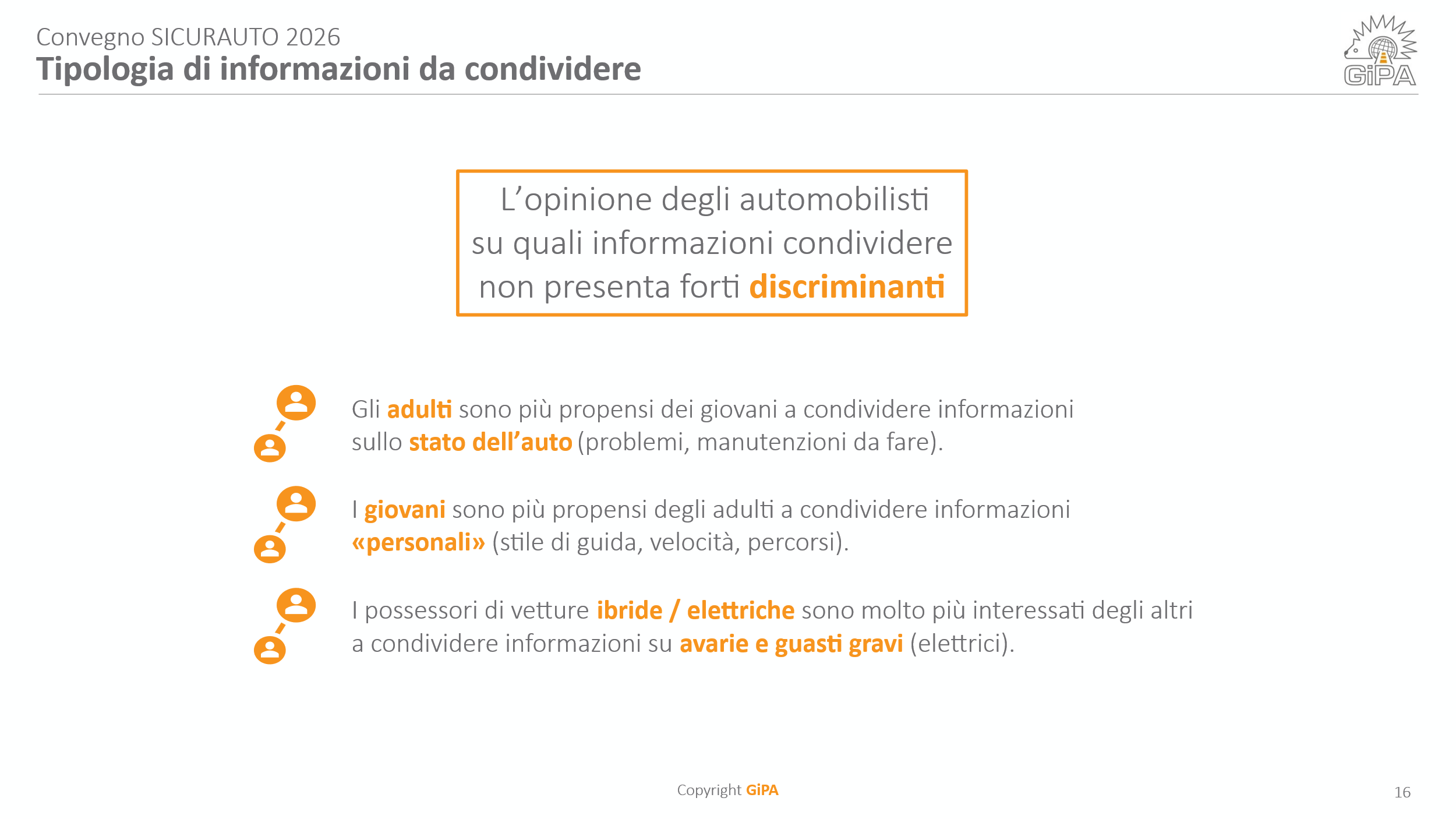
In this case there are no major differences between the various socio-demographic categories, although some variation can be seen between groups:
How is the universe of Italian repairers evolving?
The universe of repairers – according to our observatory – continues to contract, at different rates over the years, with periods of acceleration and slowdown, but always on a downward trend. One of the most significant changes in recent years has been the advent of Multiservice centres, which by definition are service points able to handle all three types of work a driver may request: repair/maintenance, tyres and bodywork.
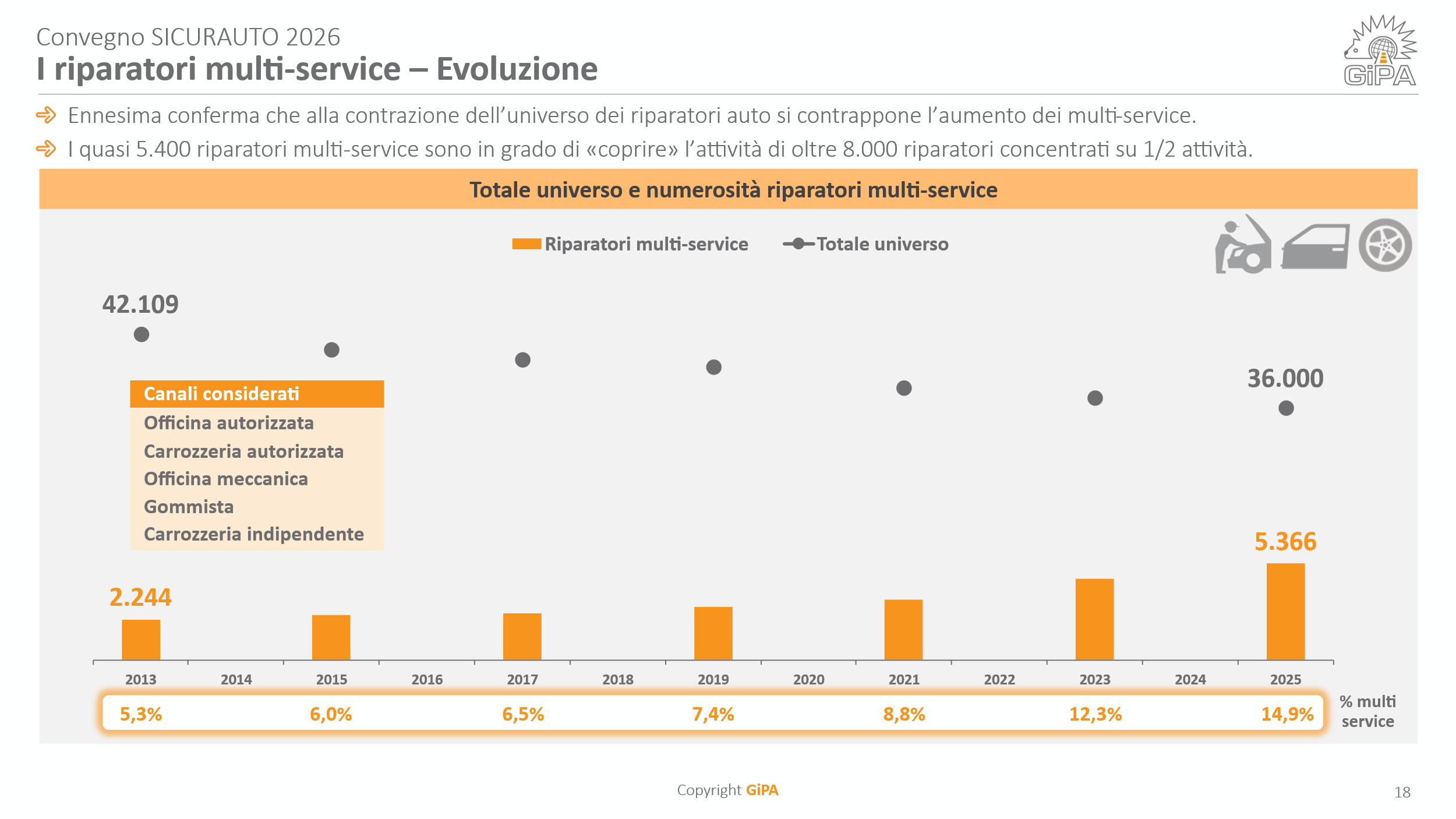
Over the years, we have therefore seen a contraction of the overall universe but an increase in the number of Multiservice centres. There are many reasons for this change, driven not so much by customer demand as by supply-side logic, with operators tending to diversify in order to become a “one-stop shop” and thus leave nothing for competitors to do on the cars that pass through their workshop.
Although still limited in number, these operators account for a growing share of the universe and, above all, they have become highly efficient, as shown in the chart below:
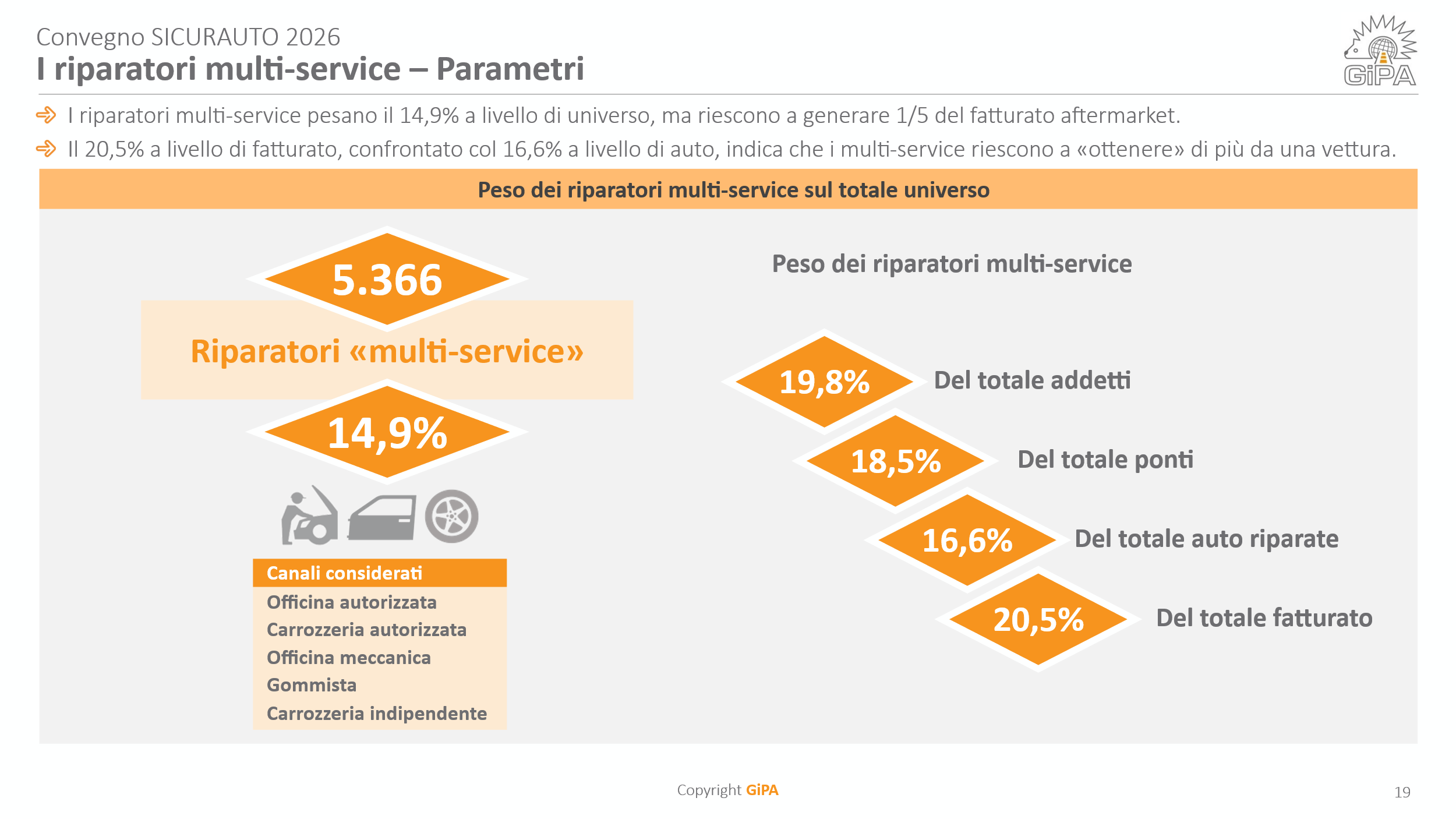
Although they represent 15% of the universe, they account for a fifth of the total turnover generated and handle over 16% of the cars repaired, offering them, on average, more complex and profitable services.
Will it be the solution for all operators? Absolutely not. It is certainly a valid opportunity, but only for businesses with a strong entrepreneurial mindset that are ready to invest in equipment, training and cultural change.