Aggiornamento OTA
From Bolt to Bit: How AI and OTA Updates Are Rewriting OEM Liability
Cars are no longer static products: software, artificial intelligence and OTA updates can change performance and safety even after the sale. A transformation that redefines the very concept of manufacturer liability
Cars are no longer static products: software, artificial intelligence and OTA updates can change performance and safety even after the sale. A transformation that redefines the very concept of manufacturer liability
For over a century, the relationship between manufacturer and car was relatively simple: the vehicle was designed, produced, sold and subsequently maintained through servicing and repairs. Today this pattern is changing radically. Contemporary cars are increasingly connected digital platforms, capable of receiving software updates remotely, collecting data, changing functions and introducing new features even many years after delivery to the customer.
This transformation raises questions that will have a profound impact on the entire automotive supply chain: who is responsible if an OTA update introduces a malfunction? How does the concept of a lack of conformity change when the product continues to evolve over time? Who is liable for damage caused by a software bug or an algorithmic decision? And what consequences can these changes have for manufacturers, independent workshops, insurance companies and consumers?
To explore these issues as part of the 6th Aftermarket Report by SICURAUTO.it, we turned to Prof. Enrico Al Mureden, Full Professor of Civil Law at the University of Bologna and author of the book “Diritto dell’Automotive” (Automotive Law), one of the most comprehensive Italian works dedicated to the legal aspects of the automobile and contemporary mobility. For many years he has worked on civil liability, product safety, consumer protection, autonomous vehicles, artificial intelligence and the digital transformation of the automotive sector. In this contribution, the Professor analyzes how software, artificial intelligence and Over-the-Air updates are progressively rewriting the very concept of manufacturer liability in the era of the connected car.
📊
This content is part of SICURAUTO.it’s 6th Aftermarket Report, titled: “The Aftermarket in the Era of European Regulations: Opportunities, Constraints and New Specializations”.
THE CAR IS NO LONGER A STATIC PRODUCT
For more than a century, automotive law has developed around a relatively simple assumption: the car was a tangible asset whose essential characteristics were defined by the manufacturer at the time of production and remained substantially unchanged throughout the useful life of the vehicle. Civil liability, product conformity, safety and even the repair market were built on this idea of “technical stability.”
The technological evolution of recent years is radically changing this paradigm. The contemporary car is no longer just a set of mechanical components, but a complex digital system, constantly connected and remotely updatable. Performance, consumption, range, safety systems, driver assistance functions and even the dynamic behavior of the vehicle can be modified through over-the-air software updates, often many years after the sale.
The vehicle is thus increasingly becoming a software-defined platform, in which software takes on a role at least equal, and sometimes superior, to that of traditional mechanical components. This is precisely where the first decisive legal question arises: the vehicle, as a product, can no longer be assessed as a closed object frozen at the time of delivery, but as a technical ecosystem that continues to change over time.

FROM THE MANUFACTURER TO THE PERMANENT VEHICLE MANAGER
In the traditional model, the manufacturer built the vehicle, placed it on the market and, except for exceptional recalls or extraordinary technical interventions, the relationship with the product tended to gradually fade. After the sale, the car essentially entered the owner’s possession and its evolution depended almost exclusively on the physical maintenance carried out over time and on the driver’s choices.
Today this pattern is changing radically. The manufacturer continues to maintain an ongoing relationship with the vehicle through software updates, cloud services, remote diagnostics systems, collection of operating data, telemetry and management of on-board digital ecosystems. The contemporary car is no longer simply sold: it continues to be monitored, updated and partly governed even after delivery to the customer.
This transformation also has a profound impact on civil liability. If the manufacturer retains the technical possibility of intervening over time on the functionality of the vehicle, it becomes increasingly difficult to argue that its liability ends once the vehicle is placed on the market. It is not a question of saying that every subsequent malfunction automatically falls on the manufacturer, but of recognising that permanent digital control also generates a permanent responsibility for organising, monitoring and updating the system.
The problem emerges particularly clearly in the context of OTA updates. An update installed even many years after sale can change driver assistance systems, safety parameters, battery management, vehicle range, engine performance or how sensors and electronic control units interact. In other words, the product does not remain static after delivery, but continues to evolve throughout its life cycle.
LACK OF CONFORMITY AND THE EVOLVING PRODUCT
The most important consequence is that the concept of lack of conformity must also be rethought. In the analogue model, the defect was normally traced back to a deviation from the characteristics promised or reasonably expected at the time of delivery. In the software-defined car, however, conformity is no longer just a snapshot taken at delivery: it becomes a dynamic condition, to be assessed in light of subsequent updates as well.
This does not mean that software that requires periodic patches should, for that reason alone, be considered inherently defective. In complex digital systems, updates are often a routine means of maintenance, correction, cyber protection and improvement of functionality. It would therefore be excessive to automatically equate the need for a patch with the existence of a defect.
The situation is different when the update is necessary to remedy a pre-existing safety risk, or when the patch introduces new malfunctions, worsens the promised performance, reduces the range, alters the behavior of ADAS or makes the vehicle less safe. In these cases, the problem is no longer the mere evolution of the software, but the loss of conformity of the product with the legitimate expectations of the user and the applicable safety standards.
For this reason, an OTA update that degrades performance or safety should not simply be classified as a factory defect in the traditional sense. It is more correct to speak of a supervening defect or evolutionary defect: an anomaly that arises after the sale, but which is still attributable to the manufacturer’s sphere of control when the remote intervention has been designed, validated, distributed or imposed by the OEM.
PRODUCT LIABILITY, AI AND SYSTEM BUGS
The question becomes even more delicate when the damage is caused by a system bug or an algorithmic decision. In these cases, it is not enough to ask which physical component has failed. The entire digital chain must be reconstructed: software design, algorithm training or validation, integration with sensors, pre-release testing, type approval, update distribution, subsequent monitoring and handling of reports.
Externally, primary responsibility will normally tend to rest with the manufacturer that placed the vehicle on the market, type-approved it, presented it as safe and has maintained digital control over it ever since. The fact that an algorithm has been developed by a third-party supplier does not, in itself, eliminate the OEM’s position vis-à-vis the user or the injured party. If anything, it may open up a distinct problem of internal allocation of liability between the manufacturer, software house, component supplier, cloud provider or digital infrastructure manager.
The expression “the algorithm’s fault” must also be used with caution. The algorithm is not a legal entity and cannot bear fault in the strict sense. Rather, its harmful “choice” must be traced back to the human and organizational decisions that made that result possible: design, data used, model limits, validation procedures, accepted risk thresholds, security controls, intervention capabilities and audit systems.
From this point of view, we are not facing an absolute regulatory vacuum. European product liability law has been updated precisely to take into account software, digital systems, connected products and new evidentiary difficulties. However, the practical challenge remains enormous: more than the absence of rules, the real difficulty will be to technically demonstrate the causal link between bug, update, algorithmic decision and damage.
OTA UPDATE LOGS, CONSENT AND NEW TECHNICAL EVIDENCE
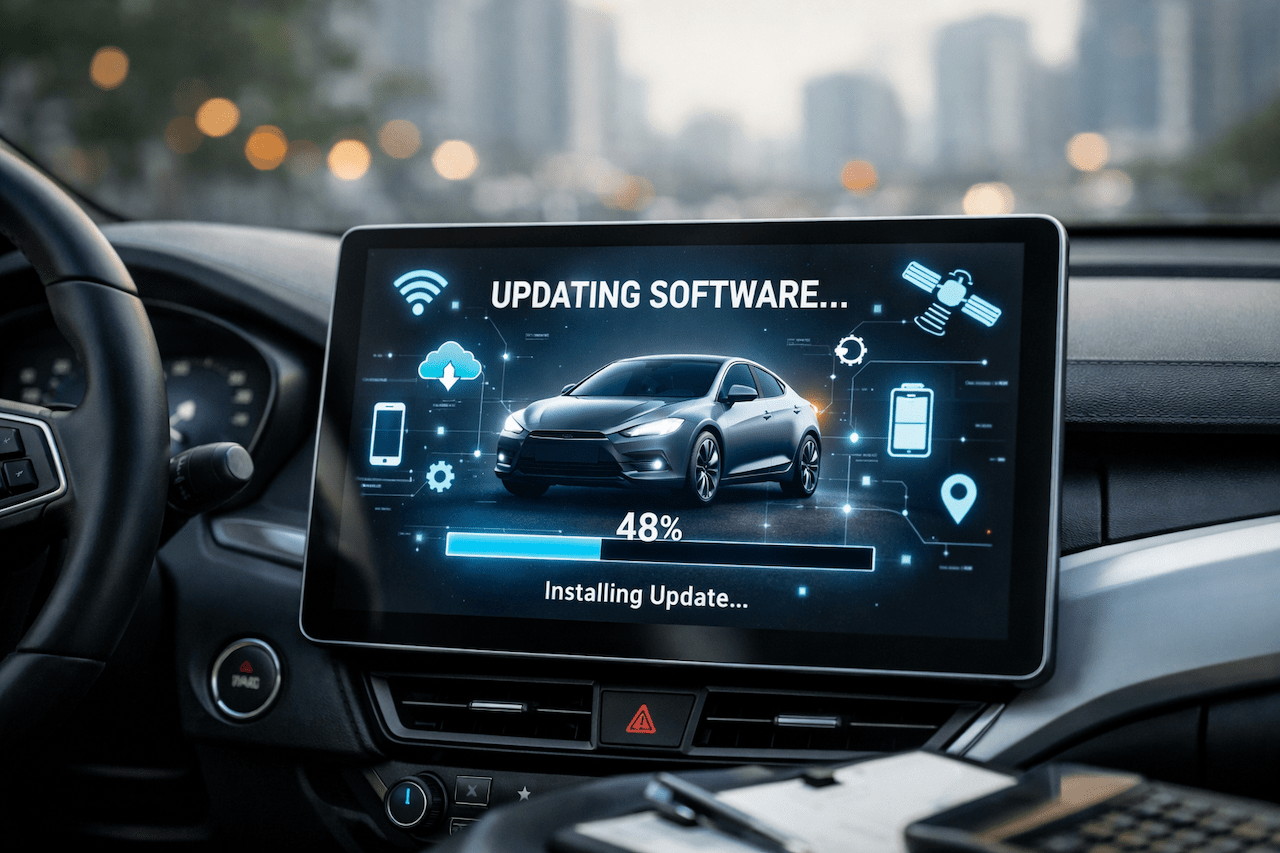
In this scenario, OTA update logs are destined to become a new kind of black box of the digital car. They will not only record speed, braking or driving events, but will be able to document which software version was installed, when an update was deployed, whether the installation was successful, which modules were modified, what errors were detected and what consent was given by the user.
Proving damage in automotive cases will therefore increasingly shift from purely mechanical investigations to a form of digital forensics applied to the car. It will be necessary to acquire logs, software versions, update history, diagnostic reports, messages sent to the user, contractual conditions, authorizations and technical documentation. The decisive point will be to prevent all this information from remaining solely in the hands of the manufacturer.
In terms of the burden of proof, the user or the injured party will normally have to allege the malfunction, the damage and the plausible connection with the update or with the digital system. But when the technical data necessary to clarify the matter are kept by the OEM, the court will have to be able to give weight to orders to produce documents, presumptions, failure to cooperate and disclosure tools. In other words, whoever controls the logs cannot also be the only party able to establish whether those logs are relevant.
The user’s consent to the updates deserves independent consideration. Consent formally obtained through an infotainment screen is not necessarily sufficient if the update changes essential vehicle functions, affects safety, reduces promised performance or alters the range. In these cases, it will be necessary to check whether the user has been informed in a clear, specific and understandable way about the technical consequences of the intervention.
DATA ACT AND DATA ACCESS: IS THE OEM MONOPOLY REALLY OVER?
The growing centrality of data is one of the most important aspects of the new digital mobility. Contemporary vehicles generate enormous amounts of information regarding component status, driving style, diagnostics, consumption, batteries, ADAS systems and software updates. This data takes on not only technical, but also economic and strategic value.
For a long time, this information remained largely under the exclusive control of car manufacturers. The real obstacle was not so much the absence of access technologies, but the proprietary control of the vehicle’s digital ecosystems and related communication interfaces.
With Regulation (EU) 2023/2854, the Data Act, the European Union sought to change this balance, recognizing users’ right to access the data generated by connected products and to authorize its sharing with third parties, including independent aftermarket operators.
The issue of access to data for connected cars deserves its own in-depth analysis. For this reason, the 6th Aftermarket Report includes a dedicated contribution by Prof. Enrico Al Mureden on the effects of the Data Act and the new competitive dynamics between manufacturers and the independent aftermarket.
CYBERSECURITY, RIGHT TO REPAIR AND OTA OVERWRITE
The increasing digitalisation of the vehicle has also made the topic of cybersecurity central. Manufacturers argue that access control to the car’s electronic systems is necessary to prevent cyber-attacks, abusive manipulation of on-board software, tampering with safety systems and unauthorised access to vehicle and user data. These are well-founded needs, especially in a context in which the car is constantly connected and increasingly dependent on software, sensors and remote communications.
However, the risk is that cybersecurity will also be used as a tool to limit independent access to repair, restrict competition in the aftermarket or hinder the interoperability of systems. In other words, cybersecurity could turn not only into a technical protection measure, but also into a new form of economic control of the vehicle’s digital ecosystem (as demonstrated by several rulings, some of which are cited in our news article on the entry into force of the recent Delegated Regulation (EU) 2026/699, ed.).
The problem becomes particularly evident when an independent repairer intervenes correctly on the vehicle and a subsequent OTA update overwrites, modifies or neutralizes that intervention. In such a case, liability cannot automatically be attributed to the repairer simply because they were the last to physically work on the vehicle. It will be necessary to verify whether the malfunction depends on the material intervention, the subsequent update or the incompatibility between the two.
Here, too, evidence will be decisive. Traceability of the intervention, diagnostic reports before and after the repair, update history, installed software versions and the manufacturer’s technical documentation will be needed. Without this information base, the risk is that independent repairers will be exposed to liabilities that are difficult to control, while the OEM continues to remotely govern the digital architecture of the vehicle.

OTA, BATTERIES AND DIGITAL PLANNED OBSOLESCENCE
A further test bed concerns OTA updates that reduce the range, charging power or performance of a battery to preserve its useful life or reduce safety risks. In the abstract, such an intervention can be legitimate when it is proportionate, technically justified and necessary to prevent a real risk. It would be unreasonable to prevent the manufacturer from intervening to avoid accelerated degradation, overheating or safety hazards.
The situation is different if the reduction in performance is presented as a neutral technical measure, but ends up significantly eroding the promised qualities of the vehicle, without adequately informing the user, without the possibility of independent verification and without proportionate remedies. In this case, the problem is no longer only software maintenance, but possible planned obsolescence via OTA (the risks of which we had already explored with the FIA in this interview as part of the 3rd Aftermarket Report, ed.).
The means of protection available are varied: remedies for lack of conformity, liability for defective products when there is damage, regulation of unfair commercial practices, right to repair, access to data and, in systemic cases, collective actions or interventions by supervisory authorities. The key will be to demonstrate that the update does not merely protect the product, but alters, in a non-transparent way, the economic and functional balance originally promised to the consumer.
From this perspective, transparency becomes essential. The user must know whether the update corrects a defect, improves a function, limits performance for safety reasons or changes the user experience for commercial reasons. The legal difference between maintenance, safety and obsolescence increasingly hinges on the ability to document the purpose, necessity and proportionality of the intervention.
FROM VEHICLE OWNERSHIP TO CODE CONTROL
The ongoing transformation is not just about automotive technology. It is primarily about how the law interprets traditional concepts such as ownership, control, maintenance, liability, data access, and product governance. In the traditional model, the owner purchased a tangible asset over which the manufacturer progressively lost control after the sale. In the contemporary digital model, on the other hand, the manufacturer continues to exercise constant power over the operation of the vehicle through software, OTA updates, data collection and cloud infrastructures that accompany the car throughout its life cycle.
The real question of the coming years will therefore be whether the car will remain an asset effectively controlled by the owner or whether it will increasingly become a digital ecosystem governed by the manufacturer. From this point of view, it is plausible that the center of gravity of responsibility will progressively shift from physical components to those who control the code, data, algorithms and updating infrastructure. We will not become just users of bits instead of owners of bolts. We will become the owners of a tangible asset whose value, safety and usability increasingly depend on digital infrastructures that remain outside our direct control. This is the fundamental legal tension of the contemporary automotive sector.
For this reason, the future of mobility will depend not only on electrification, artificial intelligence or automated driving, but also on the ability of the law to build a sustainable balance between technological innovation, safety, competition, access to data, the right to repair and user protection. The real power, in the next decade, will lie not with those who “own” the car’s data, but with those who can read it, interpret it and transform it into services, predictive maintenance and control of the relationship with the customer.
Because in the car of the future, the center of economic power may no longer be the engine, but the control of the code.