 Diogo Pinto presentazione studio FIA 2026 su auto connesse
FIA Study on Connected Cars: The Data Act Changes the Rules but Access to Data Remains Fragmented
SBD Automotive's analysis for FIA Region I, previewed at the 6th Aftermarket Report, compares the main European manufacturers and identifies opportunities and obstacles for independent digital services
SBD Automotive's analysis for FIA Region I, previewed at the 6th Aftermarket Report, compares the main European manufacturers and identifies opportunities and obstacles for independent digital services
The connected car generates a growing amount of data, but turning this information into services is still far from simple. The Data Act has changed the rules, creating new opportunities for independent operators, workshops and digital service providers. In practice, however, the ways in which manufacturers make this data available still vary widely. Accessible datasets, connection channels, APIs, authentication systems and commercial terms all vary. And there is still no common standard capable of harmonising access to information from different brands and architectures. This is the picture that emerges from the analysis “Access to car data: Impacts of new legislation and opportunities for digital services”, carried out by SBD Automotive for FIA Region I and previewed by Diogo Pinto at the launch event of the 6th Aftermarket Report by SICURAUTO.it. The study analysed the ten automotive groups with the highest sales volumes in Europe, comparing the level of access to data, sharing with third parties, the breadth of information available, interoperability and business models. For the aftermarket, therefore, the challenge is no longer just obtaining the data, but being able to use it in a reliable, standardised and sustainable way to build new services.
📊
This content is part of SICURAUTO.it’s 6th Aftermarket Report, titled: “The Aftermarket in the Era of European Regulations: Opportunities, Constraints and New Specializations”.
FROM RIGHT OF ACCESS TO ACTUAL DATA AVAILABILITY
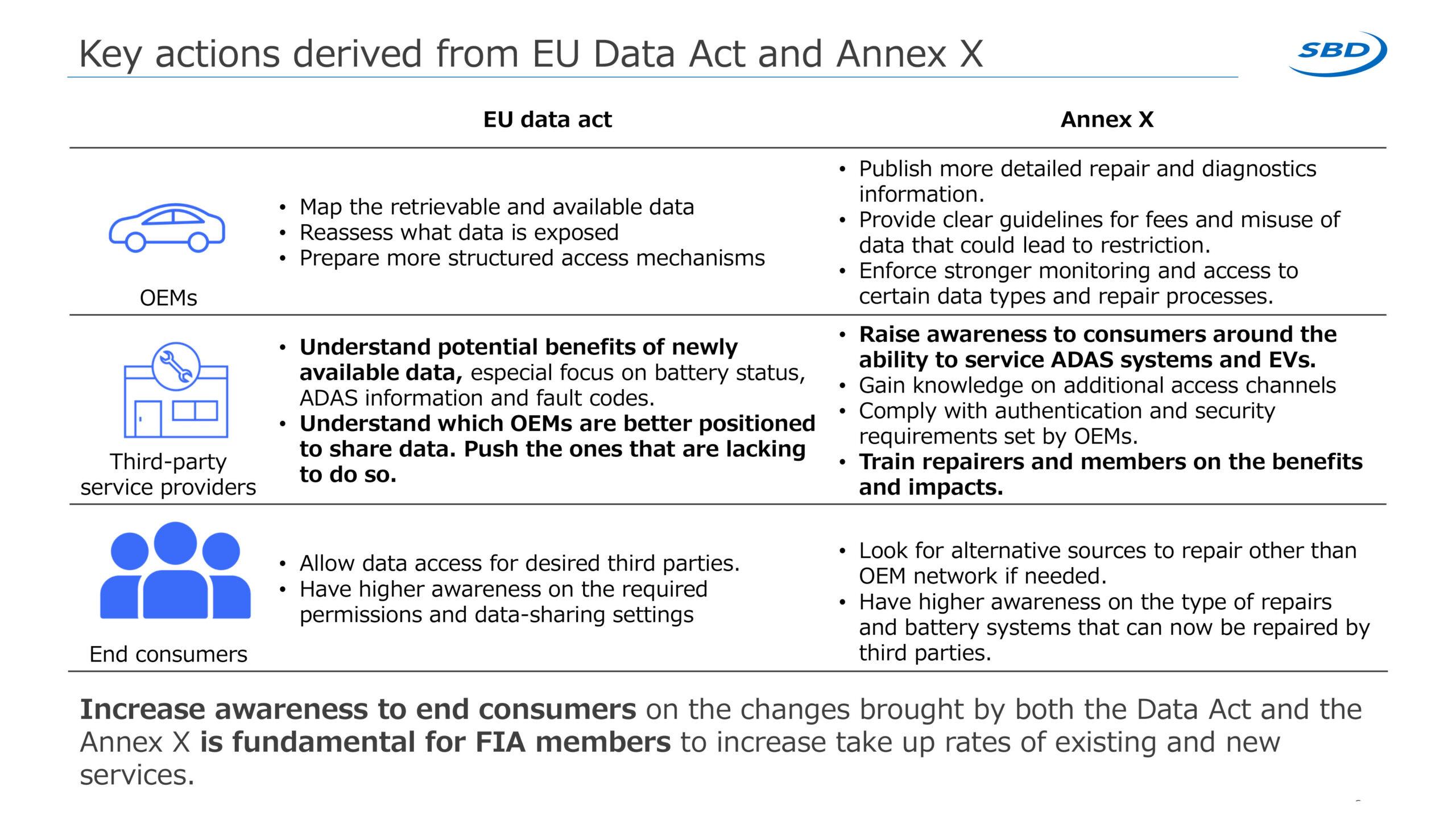
The first change concerns the very way we look at the data generated by a connected vehicle. The framework introduced by the Data Act and Annex X expands the possibilities of access for parties other than the manufacturer, but does not translate into blanket availability of all the information produced by the vehicle.
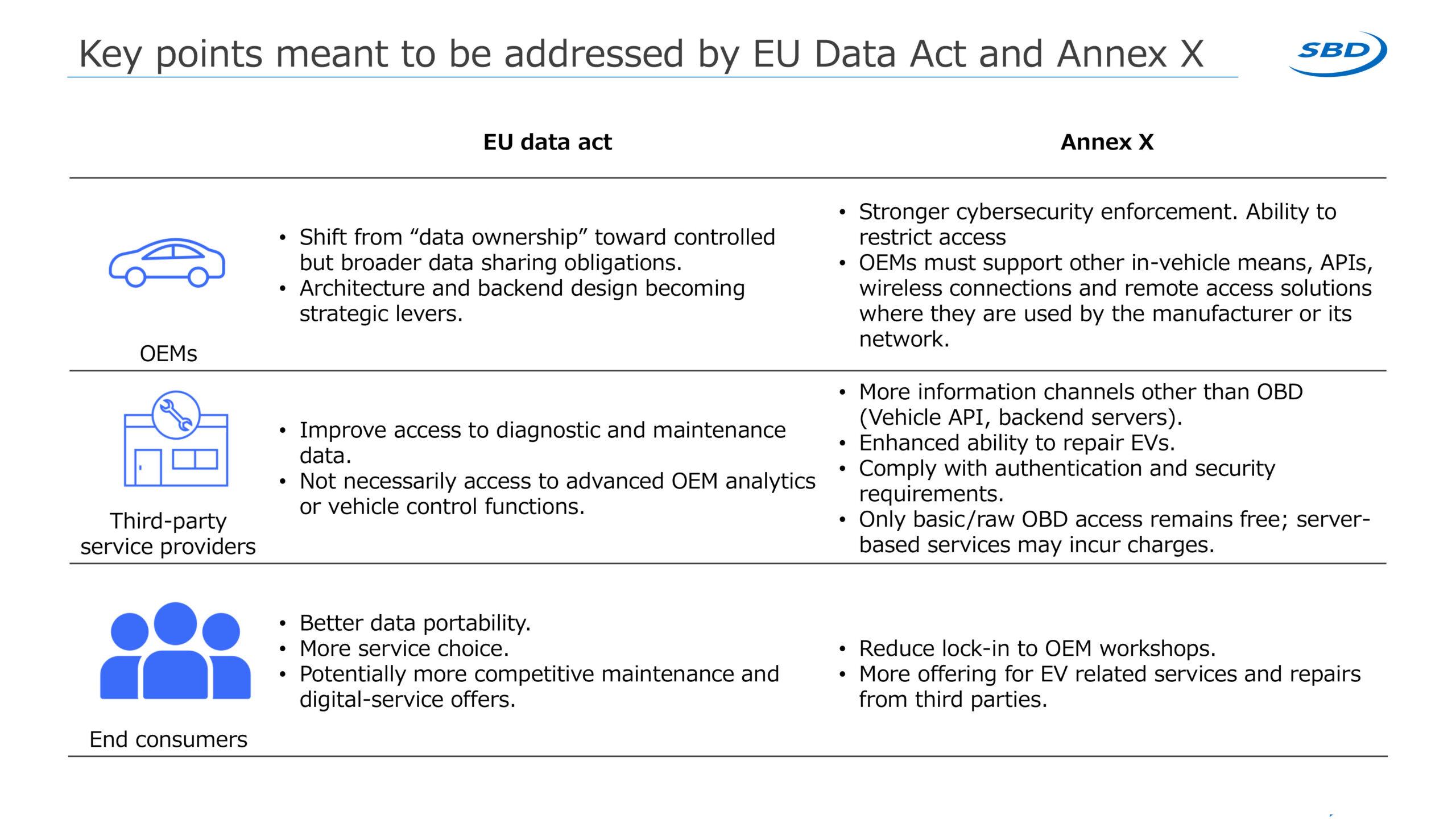
Independent operators gain the opportunity to access diagnostic and maintenance data, including through channels other than traditional OBD. Vehicle APIs, manufacturer backends, wireless connections and remote access can become new entry points, while basic OBD access continues to be a distinct layer. Services based on manufacturers’ servers may also be subject to charges.
For an aftermarket operator, this can mean having information that goes beyond what is normally obtainable through traditional diagnostics, with a particular focus on battery status, ADAS data and fault codes.
But the new framework does not eliminate the need to comply with authentication and security requirements, nor does it guarantee that every category of data or vehicle function is accessible to third parties. Indeed, the SBD analysis stresses that access to data does not necessarily imply the availability of advanced OEM analytics or vehicle control functions.
This is where the first gap opens up between the right of access and its practical application: knowing that data must be made available does not yet mean knowing through which interface it can be obtained, at what level of detail, under what conditions and at what cost.
IT’S NOT JUST OBD: API’S, BACKENDS AND NEW ACCESS CHANNELS
For years, OBD has been one of the main access points to vehicle data. With the evolution of connected cars, however, an increasingly significant part of the information is processed and made available through the manufacturer’s digital architecture. This is where the new scenario becomes more complex.
In fact, SBD’s analysis highlights the possibility of using Vehicle APIs, manufacturers’ backends, wireless connections and remote access systems, alongside traditional methods. For service providers, this means being able to tap into information that does not necessarily pass through the diagnostic port and that can be used to develop new services.
Beyond diagnostic information, data on battery, ADAS, telematics, vehicle usage and, in some cases, charging and location become particularly valuable. But the availability of this information is not uniform across manufacturers: quantities, categories and methods of access still depend on the architecture and solutions adopted by each OEM.
For the aftermarket, therefore, new ground is opening up. The ability to work with connected vehicle data will no longer depend solely on workshop equipment, but also on the ability to interface with digital infrastructures, manage authentication and authorisations and integrate data from different sources.
This leads directly to the next issue: if each manufacturer is developing its own access methods, how uniform really is the market that the Data Act is meant to help open up?
MANIFACTURERS DON’T START FROM THE SAME POINT
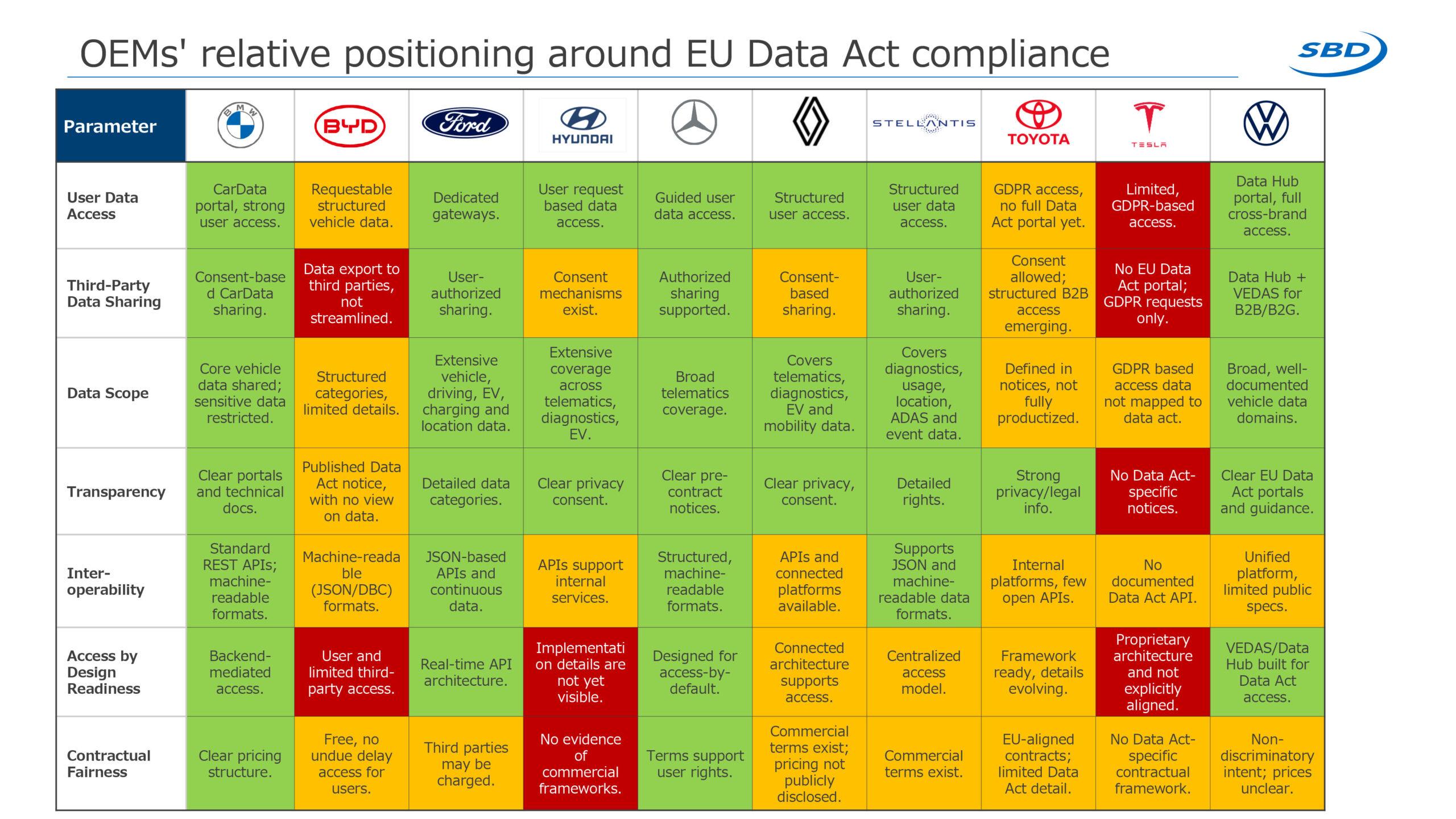
The European framework sets new conditions for access, but their practical application still varies widely from one manufacturer to another. This is one of the most striking findings of the SBD analysis, which looked at the ten OEM groups with the highest sales volumes in Europe to understand how ready they actually are to make vehicle data available.
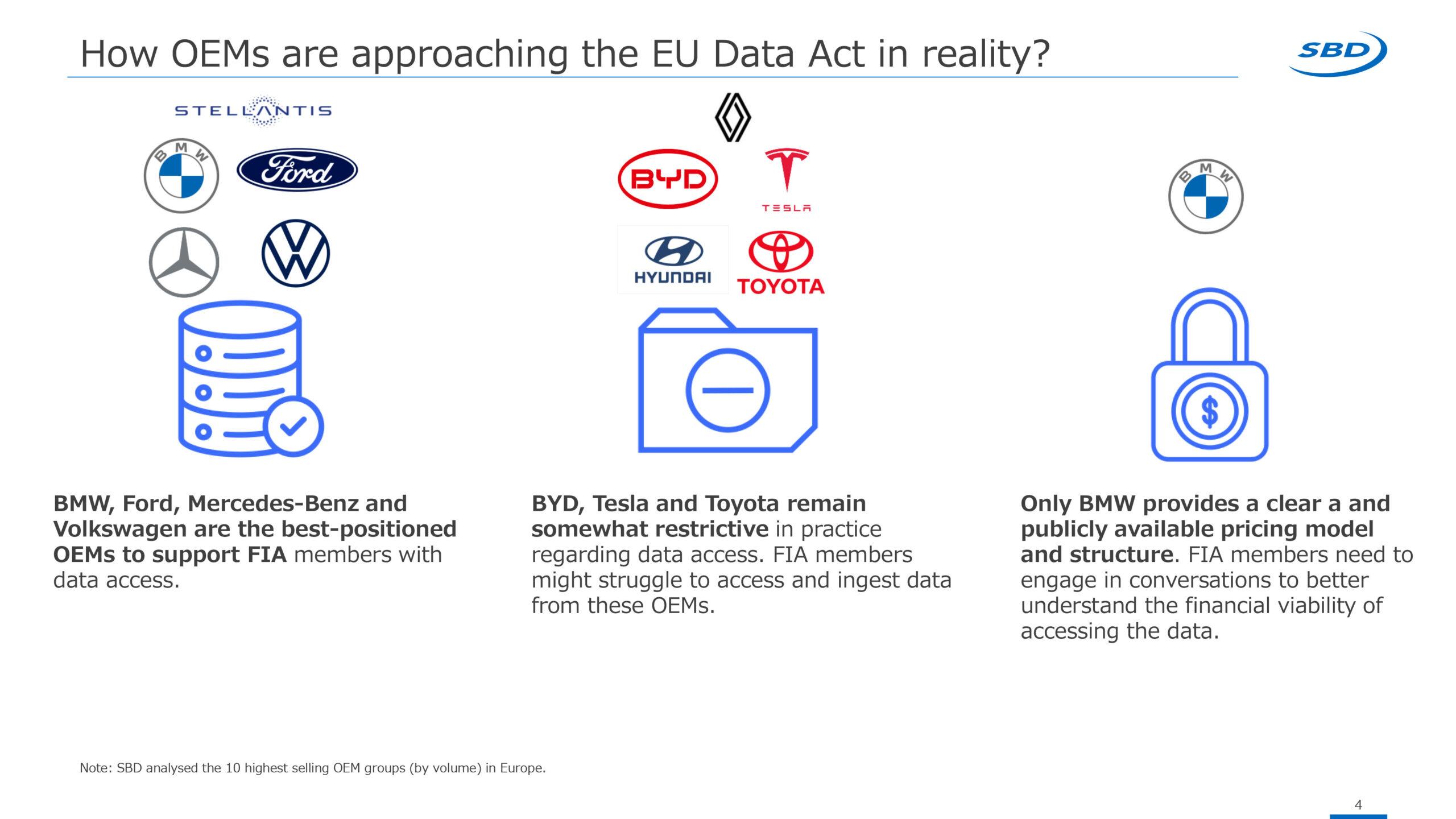
According to the study, BMW, Ford, Mercedes-Benz and Volkswagen are now better positioned to support access to data by FIA members. In contrast, BYD, Tesla and Toyota are identified as more restrictive in practice, with possible difficulties for independent operators in accessing and acquiring data.
However, the difference is not only in technical availability. A particularly significant element is the economic model: according to SBD, BMW is the only manufacturer among those analysed to offer a clear, publicly available pricing model and fee structure. For the others, operators still have to engage directly with manufacturers to understand the costs and sustainability of access.
The picture, therefore, does not show a market in which access to data is simply “open” or “closed”. There are different levels of maturity, with infrastructures, sharing methods and commercial conditions that can change significantly from one OEM to another.
And it is precisely this difference that makes SBD’s subsequent comparative analysis particularly significant: not just establishing who allows access, but understanding what is made available, through what tools and with what degree of transparency.
SAME MARKET, VERY DIFFERENT DATA: THE INTEROPERABILITY PROBLEM
The picture becomes even more complex when we look at how data is made available. Having an access system does not mean offering the same wealth of information, nor using the same technical methods to make it available.
The comparison developed by SBD considers several parameters: access to user data, sharing with third parties, breadth of datasets, transparency, interoperability, access-by-design readiness and contractual terms. The picture that emerges is very heterogeneous.
The differences are also significant in terms of content. Some manufacturers provide information including telematics, diagnostics, EV data, charging and location; others offer more limited coverage or have not yet fully structured access in line with the Data Act. The same applies to technical methods: these range from REST APIs and machine-readable formats to proprietary platforms, dedicated gateways or systems in which access methods are still evolving.
For an operator developing multi-brand services, the problem therefore becomes integrating and normalising information from different ecosystems, despite differing formats, APIs and structures.
This is one of the reasons why SBD stresses the need to work on the standardisation of datasets and access methods. Without a common language, the risk is that opening up data will produce many distinct ecosystems instead of a truly interoperable digital market.
DATA COMES AT A PRICE: WHEN ACCESS BECOMES A BUSINESS CASE
Access to data can open up new opportunities, but to turn them into sustainable services there is another variable to consider: how much it costs to obtain that data.
The SBD analysis shows that, among the manufacturers examined, BMW is the only one to provide a clear, publicly available pricing model and fee structure. For the other OEMs, commercial terms vary, but in several cases prices are not made public and operators have to engage directly with the manufacturer to assess their economic viability.
The issue becomes even more relevant considering that not all services have the same needs. A roadside assistance application, for example, may need to query the vehicle when a certain event occurs. Other services, such as those based on continuous monitoring or driving behaviour profiling, require a constant flow of information.
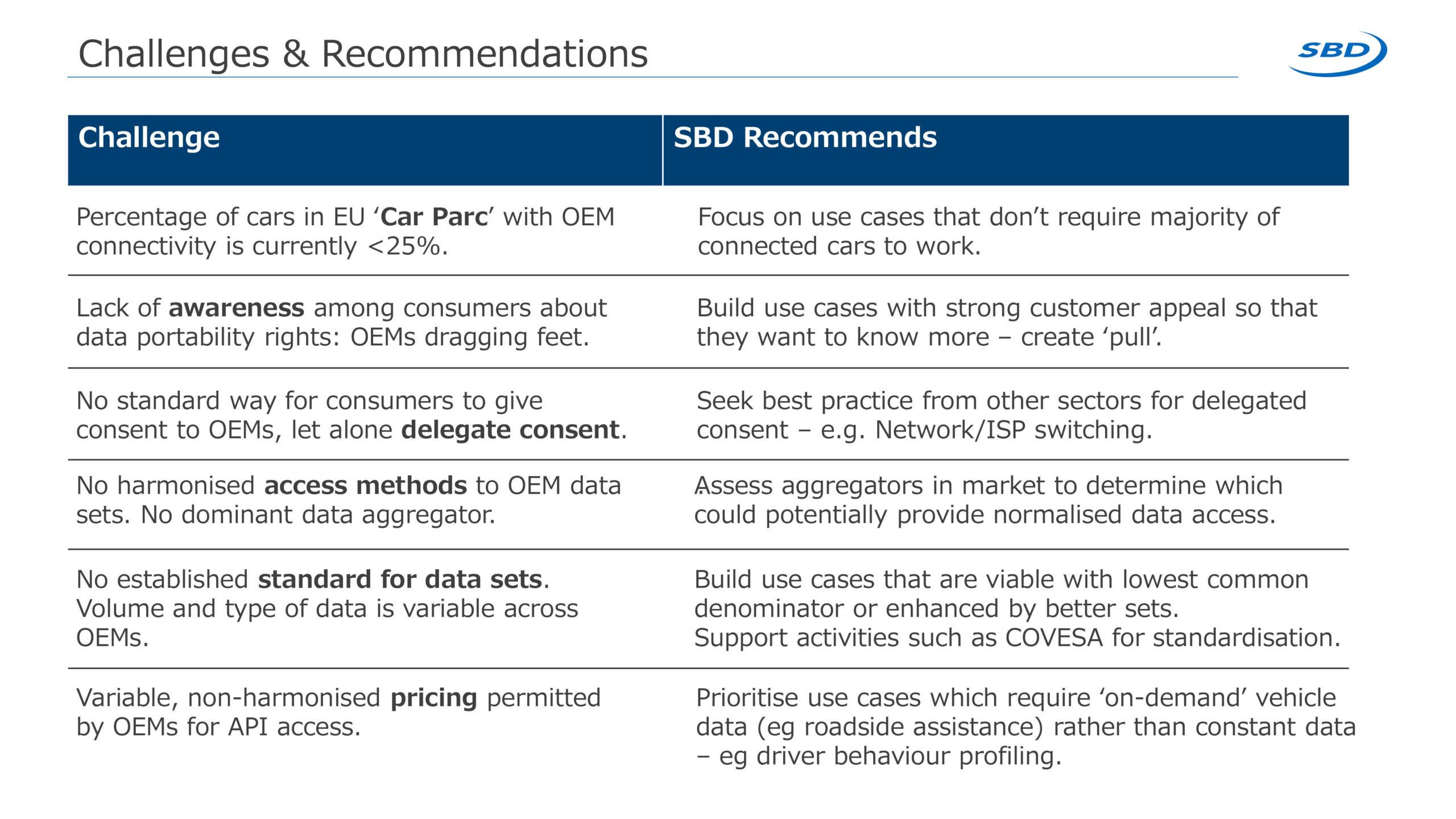
For this reason, SBD suggests initially favouring use cases that require “on-demand” data, avoiding business models that depend from the outset on continuous and potentially more expensive availability.
For an aftermarket operator, every new service must therefore solve a genuine economic equation: value of the data, frequency of access, costs charged by the OEM and the ability to transform that information into a service for which the customer is willing to pay.
In this scenario, the transparency of commercial conditions becomes almost as important as the technical availability of the data.
WITHOUT THE MOTORIST’S CONSENT, DATA DOES NOT REACH THE MARKET
Then there is another step that can determine the actual uptake of new services: the role of the motorist. The Data Act can expand the possibilities of access, but in order for a third-party operator to use that data, the customer needs to know their rights and be able to authorise its sharing.
According to SBD, consumer awareness of data portability is still limited today. Added to this is the absence of a shared standard for collecting consent and, above all, to allow the motorist to delegate it to a third party.
A digital service may be technically ready, but if the user has to go through complex procedures to authorise access, the barrier simply shifts from technology to user experience.
For this reason, the analysis suggests working on use cases capable of creating a concrete demand from the customer: services with a value evident enough to prompt the motorist to find out more, grant the necessary authorisations and choose an operator outside the manufacturer’s network. In this sense, SBD speaks of creating a “pull” effect, i.e. a demand generated by the consumer’s interest in the service.
The consumer therefore becomes a genuine link in the chain: not only the recipient of the service, but the party who enables access to the data. And for the aftermarket, this means that the game will not be played solely on regulatory and technological grounds, but also on the ability to explain to motorists what new options are available to them.
FEWER THAN ONE IN FOUR CARS IS CONNECTED: IT IS STILL EARLY DAYS
However, one figure puts the immediate scope of these opportunities into perspective: fewer than 25% of cars in the European car parc currently have OEM connectivity.
It means that access to connected car data, although set to become increasingly important, still concerns a minority of the car parc. For aftermarket operators, this introduces a very concrete constraint: building a service that depends on the availability of connectivity would mean, at least today, targeting a vehicle base that is still relatively small.
SBD therefore suggests focusing on use cases that do not require a majority of connected cars in order to function, or that can still deliver value even when the quantity and quality of available data vary from one vehicle to another.
The growth of the connected vehicle parc will progressively expand the potential customer base, but an aftermarket service must also be sustainable in today’s market, without waiting for connectivity to become standard across the entire parc.
The path, therefore, does not start from a market that is already fully digitised. It starts from a heterogeneous vehicle parc, in which vehicles with very different levels of connectivity and access to data coexist. And it is precisely on this reality that the next generation of services will have to be built.
THE REAL CHALLENGE FOR THE AFTERMARKET: TURNING ACCESS INTO SERVICES
At this point, the question is no longer just how accessible the data is, but what can be built from that data. And it is precisely here that the SBD analysis shifts the focus: towards use cases and the conditions needed to make them genuinely sustainable.
The recommendation is to start with services that can work even in the presence of different datasets and non-uniform levels of access, using the so-called “lowest common denominator” as a reference: what is available consistently enough across different manufacturers. Richer datasets can then become a source of added value, rather than an essential requirement for the service to work.
At the same time, SBD points to standardisation as one of the steps needed to reduce the current fragmentation and cites initiatives such as COVESA. Another option is offered by aggregators already on the market, to be assessed on their ability to offer normalised access to data from multiple OEMs.
For the aftermarket, this opens up an interesting perspective. The competitive advantage may not simply be in having access to more data, but in the ability to integrate, normalise and transform disparate information into an easy-to-use service.
This is probably the decisive step in the new scenario: the Data Act may create the conditions for wider access, but it will be technology, standards, business models and the ability to build services useful to the motorist that will determine how much of this opportunity will actually translate into new value for the aftermarket.
A NEW INFRASTRUCTURE FOR THE AFTERMARKET
The picture that emerges from SBD Automotive’s analysis for FIA Region I is that of a market that is changing, but has not yet found a uniform model. The Data Act introduces new possibilities of access, while manufacturers, independent operators and technology suppliers are still defining tools, standards and ways to transform them into services.
For the aftermarket, the challenge will be to transform this new availability into interoperable, economically sustainable services capable of generating a concrete benefit for the motorist.
It is a process that is still under construction. But it is precisely at this stage, between new rules and infrastructures that still need to be consolidated, that new service models and new specialisations for the independent aftermarket can emerge.