 Diagnosi meccatronico
EDIC Certificates: the New Digital Identity that Will Change Access to Vehicle Diagnostics
An exclusive preview for SICURAUTO.it from Digidentity reveals how the new system will work: three access levels, certification of independent operators and technicians, digital authentication and what changes compared with SERMI
An exclusive preview for SICURAUTO.it from Digidentity reveals how the new system will work: three access levels, certification of independent operators and technicians, digital authentication and what changes compared with SERMI
Access to a vehicle’s on-board diagnostics (OBD) is entering a new phase in Europe. The change is driven by a simple but increasingly important need: independent workshops must be able to access the vehicle information and diagnostic functions they need, while vehicle manufacturers must also be able to protect modern vehicles against unauthorised or potentially harmful access.
The legal starting point is Regulation (EU) 2018/858, which establishes the right of independent operators to have unrestricted, standardised and non-discriminatory access to vehicle OBD information and repair and maintenance information (RMI). In other words, the legislation is designed to ensure that independent repairers are not prevented from diagnosing and repairing vehicles simply because they are outside the manufacturer’s authorised network.
However, the increasing cybersecurity complexity of modern vehicles created a difficult question: how can manufacturers protect secure vehicle systems while respecting this right of access? This issue became particularly significant following the European Court of Justice’s judgment in Case C-296/22, commonly known as the Carglass case, which created uncertainty around the extent to which manufacturers could impose additional security conditions on OBD access.
📊
This content is part of SICURAUTO.it’s 6th Aftermarket Report, titled: “The Aftermarket in the Era of European Regulations: Opportunities, Constraints and New Specializations”.
THE TURNING POINT: OBD ACCESS IS ENTERING A NEW SECURITY ERA
That situation has now changed. Commission Delegated Regulation (EU) 2026/699, adopted on 23 March 2026 and in force since 23 June 2026, amends Annex X of Regulation 2018/858 and introduces a new Appendix 4, specifically establishing the conditions under which security measures such as certificates and tokens can be used to protect access to OBD information. The objective is not to close the door to independent repairers, but to create a common and non-discriminatory way of proving who is accessing the vehicle and what level of access is required.
This is where the EDIC Certificate (European Diagnostic Identification Certificate, initially it was supposed to be called “OBD Certificate”) comes in. It creates a new, progressive assurance framework for independent operators, with different levels of identification and access depending on the sensitivity of the diagnostic activity. And, importantly for the aftermarket, it does not replace SERMI: the two systems are designed to work alongside each other.
WHAT IS THE EDIC CERTIFICATE?
The European Diagnostic Identification Certificate (EDIC) scheme provides a common and non-discriminatory framework for independent operators to access vehicle diagnostic functions at an appropriate level of assurance. Its purpose is to bridge the gap between the right of access established by the European type-approval framework and the cybersecurity requirements that vehicle manufacturers must meet as vehicles become increasingly connected and software-defined.
The key principle is proportionality. Not every diagnostic operation presents the same level of security risk, so the scheme does not impose a single certification requirement for every activity. Instead, it introduces a progressive assurance model, with different levels of certification depending on what the operator needs to do on the vehicle.
For the aftermarket, this distinction is important. A workshop carrying out routine diagnostic work — such as reading and clearing fault codes, checking sensor values or performing certain adaptations and adjustments — does not face the same security requirements as an operator carrying out a security-sensitive operation such as immobiliser or key-related work.
The EDIC Certificate therefore establishes a structured way to identify who is accessing the vehicle, on whose behalf they are acting and what level of access they are authorised to obtain. The scheme covers OBD access performed by an operator using a diagnostic tool and is designed to provide a common framework across the European Union, rather than requiring independent operators to negotiate separate authentication arrangements with individual vehicle manufacturers.
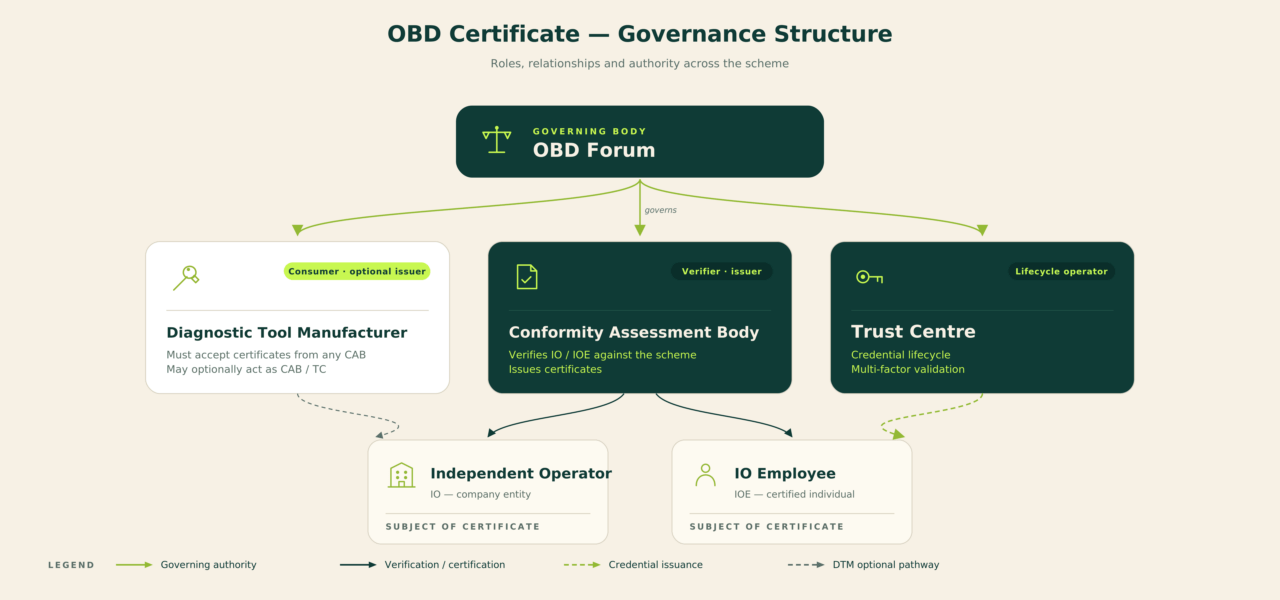
At the centre of the system are the Independent Operator (IO) — the workshop or company — and the Independent Operator Employee (IOE), the individual technician. Depending on the level required, the certificate can therefore identify either the company or the specific person carrying out the work.
EDIC CERTIFICATE AND SERMI: COMPLEMENTARY, NOT ALTERNATIVE
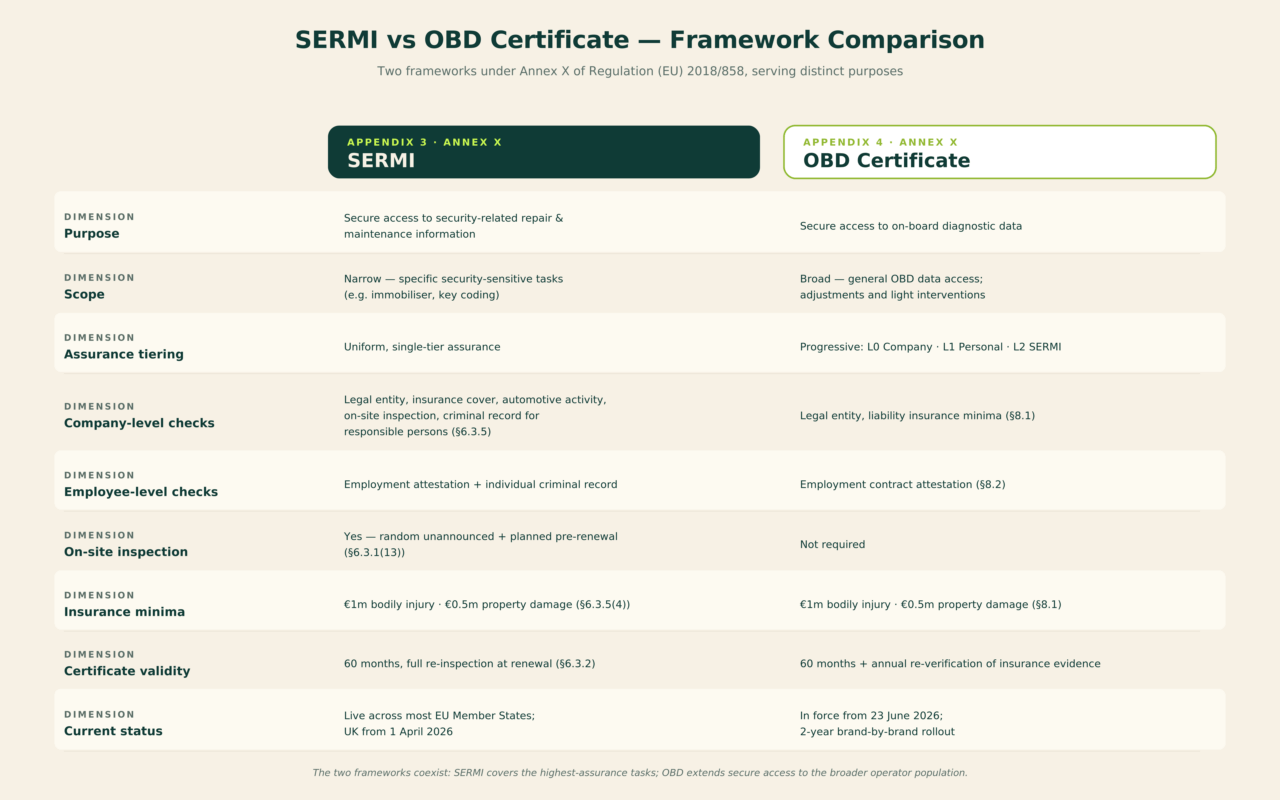
One of the most important points to understand about the new framework is that the EDIC Certificate does not replace SERMI. The two schemes are designed to coexist, but they address different levels of security and different types of diagnostic and repair activities.
SERMI remains the high-assurance route for security-sensitive operations defined under Appendix 3 of Annex X, such as immobiliser resets, key coding and similar activities. The EDIC Certificate, introduced through the new Appendix 4, provides a broader framework for secure access to OBD functions, covering a much wider range of diagnostic activities.
The easiest way to understand the relationship is to think of the two systems as different layers of the same access framework.
At Level 0, the certificate identifies the Independent Operator (IO) — the company or workshop. This is the lowest assurance level and is intended for activities that do not require identification of a specific technician.
At Level 1, the certificate identifies the Independent Operator Employee (IOE) — the individual technician carrying out the work. This level covers Level 0 access as well as a broader range of activities, including software updates, parts coding and similar operations where individual attribution is relevant for cybersecurity or auditing purposes.
At Level 2, the operator holds a SERMI certificate. This is the highest-assurance level and covers the security-related repair and maintenance activities governed by Appendix 3. Level 2 is therefore subject to the additional requirements of the SERMI scheme, including the relevant inspection and verification procedures.
The levels are cumulative: a Level 1 certificate also provides Level 0 access, while a Level 2 certificate covers all three tiers.
| Level | Who is identified? | Typical scope | Assurance |
|---|---|---|---|
| Level 0 | Company / IO | Lower-tier OBD access, such as certain resets and calibration tasks | Basic |
| Level 1 | Individual technician / IOE | Broader diagnostic activities, software updates, parts coding and similar functions | Intermediate |
| Level 2 | Individual technician / IOE | Security-related activities such as key coding and immobiliser-related operations | High – SERMI |
For an independent workshop, the practical message is therefore relatively straightforward: routine diagnostics do not automatically become SERMI activities simply because the vehicle has a secure diagnostic gateway. Instead, the required level of assurance depends on the activity being performed.
This distinction is central to the new framework. The objective is to make the certification burden proportionate to the risk, allowing operators performing routine diagnostic work to access the functions they need without being subjected to the same requirements as technicians performing the most security-sensitive operations.
In this sense, the EDIC Certificate can be seen as the broader baseline for secure OBD access, while SERMI remains the higher-assurance layer for the activities where a stronger level of trust and individual identification is required.
HOW WILL IT WORK IN THE WORKSHOP?
Once an EDIC Certificate has been issued, the process is designed to make secure access to protected diagnostic functions as straightforward as possible for the technician. The certificate acts as a digital credential, linking the workshop or individual technician to an authorised level of access.
The operational flow described by Digidentity can be summarised in four main steps.
- The technician presents the EDIC Certificate
The Independent Operator Employee (IOE) presents the certificate to the diagnostic tool, typically by scanning a QR code displayed by the Diagnostic Tool Manufacturer (DTM) using the Digidentity Wallet on their smartphone. The tool records the certificate presentation in its audit log.
- The diagnostic tool validates the certificate
The diagnostic tool sends the certificate to the Trust Centre, which checks that the credential is authentic, valid, within its validity period and has not been revoked. Multi-factor authentication is used to bind the presentation to the individual. If the checks are successful, the Trust Centre returns an authorisation token to the diagnostic tool.
At this point, the diagnostic tool has received confirmation that the certificate is valid and that the presentation has been successfully authenticated.
- The tool requests access to the vehicle’s secure gateway
For vehicles where access to the diagnostic gateway is required, the diagnostic tool then communicates with the vehicle manufacturer’s back-end service. The VM verifies that the tool is authenticated and, where applicable, that the operator’s certificate is valid for the requested activity.
If the requirements are met, the VM issues a time-bound gateway access key. The diagnostic tool can then use this key to establish a session with the vehicle through its OBD port.
- The technician performs the authorised task
The vehicle grants access according to the scope permitted by the certificate level. The technician can therefore perform the diagnostic or maintenance operation for which access has been authorised.
Importantly, the process also creates an audit trail. The diagnostic tool can record the protected actions performed, linking them to the certificate presented and to the gateway session.
The white paper illustrates this process with a Level 1 climate-control service. In that example, the technician first performs a pre-scan, authenticates using the Level 1 certificate, obtains access through the vehicle manufacturer’s secure gateway and carries out the required service. A post-scan then provides a comparison with the initial vehicle status.
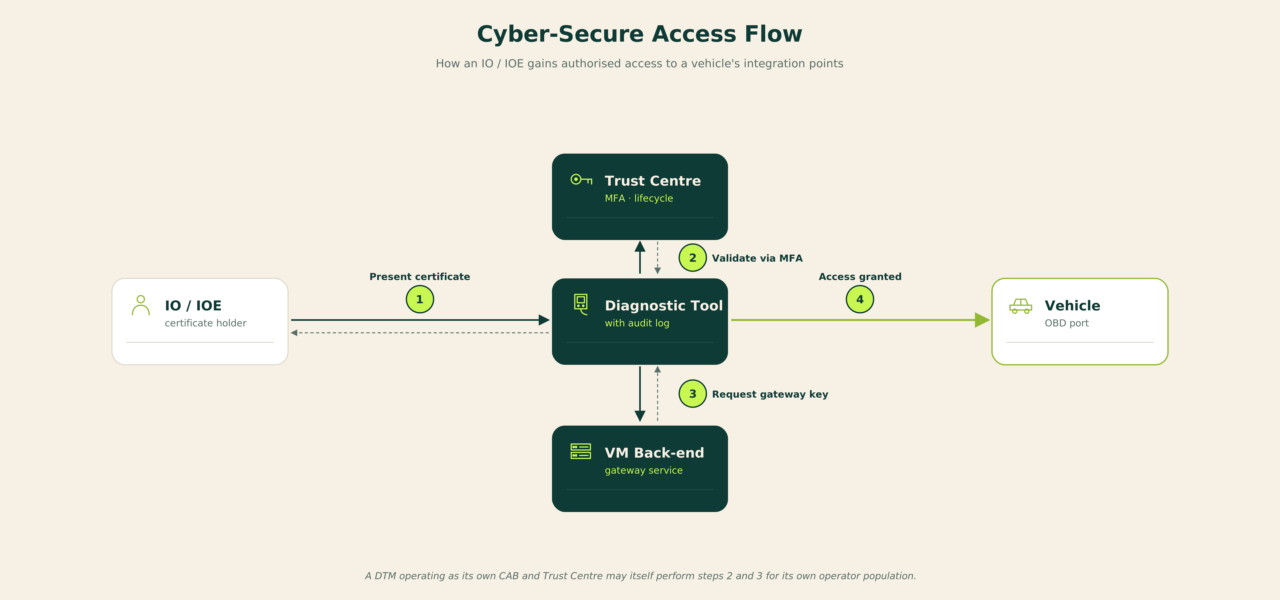
The result is a model in which identity, authorisation and vehicle access become connected parts of the same diagnostic process. For the workshop, the visible action may ultimately be as simple as presenting a digital credential to the diagnostic tool; behind that action, however, several systems are working together between the technician, the DTM, the Trust Centre and the vehicle manufacturer.
WHAT WILL AN INDEPENDENT WORKSHOP HAVE TO DO?
For independent workshops, the introduction of the EDIC Certificate means that access to protected diagnostic functions will increasingly be linked to the formal identification and verification of both the company and, where required, the individual technician.
The process starts with the Independent Operator (IO) applying to a Conformity Assessment Body (CAB). The application identifies the company, the certificate level or levels required and, for Level 1 and Level 2, the employees who are to be authorised. Under the 11th edition of the SERMI Sanctioned Interpretations, published in July 2026, the application can be submitted to a CAB operating in another Member State, although the practical implications of cross-border certification are still being clarified.
The CAB then carries out the necessary verification. At company level, this includes checking the legal existence and standing of the business, proof of ownership and liability insurance. For EDIC Certificate approval, the minimum insurance coverage specified in Appendix 4 is €1 million for bodily injury and €0.5 million for property damage.
For Level 1 and Level 2, the process also moves from Know Your Business (KYB) to Know Your Customer (KYC): each authorised employee must be individually verified, with employment confirmed through an employment contract. Level 2 adds the specific SERMI requirements, including the relevant criminal-record check and on-site inspection of the workshop premises.
Once the checks have been completed, the CAB instructs the Trust Centre to issue the certificate. The credential is bound to the company or individual, depending on the level, and made available to the operator. For individual certificates, Digidentity describes an activation process in which the technician receives an activation link and activates the credential in the Digidentity Wallet on their device.
There is also an important difference between the EDIC Certificate and SERMI in terms of the administrative burden. EDIC Certificate approval does not require the on-site inspection associated with Level 2/SERMI, which is intended to make certification more accessible to a broader population of independent operators.
EDIC Certificates are valid for 60 months. During that period, evidence of liability insurance is re-verified to ensure continued compliance, while renewal is required at the end of the validity period. Level 2 follows the SERMI renewal cycle, including the additional on-site inspection.
For the typical independent workshop, therefore, the practical message is relatively simple: the company needs to be approved, the appropriate employees need to be identified and certified where required, and the workshop must maintain the necessary insurance and compliance requirements. Once this is done, the certificate becomes the digital credential used when protected diagnostic access is required.
This also introduces a new element into the relationship between the workshop and its diagnostic equipment: the certificate is not tied to a single vehicle manufacturer or necessarily to a single diagnostic tool. Under Appendix 4, Diagnostic Tool Manufacturers must accept EDIC certificates issued by any CAB, supporting the interoperability that is intended to make the system work across the European aftermarket.
THE CRITICAL FACTOR: VEHICLE MANUFACTURER READINESS
Obtaining an EDIC Certificate will be an important step for an independent workshop, but it does not mean that every protected diagnostic function will immediately be available on every vehicle.
This is one of the most important practical aspects of the new framework. The rollout of EDIC Certificates is expected to take place brand by brand, because the system also depends on the readiness of each vehicle manufacturer (VM) and the integration of its back-end systems with the new framework.
In practice, the certificate is only one part of the access chain. The diagnostic tool must be able to validate the certificate through the Trust Centre, while the vehicle manufacturer’s back-end must also be ready to authenticate the tool and, where required, verify that the operator’s certificate covers the requested activity.
This means that a workshop could be properly certified and using a compatible diagnostic tool, but still be unable to perform a particular protected operation on a particular vehicle if the relevant vehicle manufacturer’s secure gateway and back-end are not yet integrated with the EDIC Certificate framework.
Digidentity’s illustrative Level 1 use case makes this dependency particularly clear. After the technician’s certificate has been validated, the diagnostic tool requests access to the vehicle’s secure gateway from the manufacturer’s back-end. If that back-end is not yet integrated for the relevant brand, the process stops at that point, regardless of the operator’s certification status.
This is why the transition should not be viewed as a single European “switch-on” date. The regulatory framework is already in force, but its operational implementation will develop progressively across vehicle manufacturers and diagnostic tools.
For independent workshops, this distinction will be crucial during the transition period. Certification establishes the operator’s eligibility and level of assurance; actual access will also depend on the technical readiness of the vehicle manufacturer, the diagnostic tool and the specific vehicle population concerned.
The new framework therefore creates a common European foundation for secure OBD access, but the aftermarket will still have to navigate a progressive, brand-by-brand rollout before the system reaches its full operational scope.
WHEN WILL EDIC CERTIFICATES ACTUALLY ARRIVE?
Although Delegated Regulation (EU) 2026/699 entered into force on 23 June 2026, the practical rollout of the EDIC Certificate scheme will not happen on a single date across the European aftermarket. The regulatory framework is already in place, but the technical implementation is being phased in, with different obligations taking effect over the coming two years.
The key milestones are:
23 March 2026 — Commission Delegated Regulation (EU) 2026/699 is adopted.
23 June 2026 — The Regulation enters into force and the requirements of the new Appendix 4 become applicable.
16 July 2026 — The 11th edition of the SERMI Sanctioned Interpretations is published, including amendments related to the new regulation and provisions supporting cross-border CAB inspections.
23 September 2026 — Vehicle manufacturers must provide API information for non-software-update activities.
23 December 2026 — General deadline for vehicle manufacturers to provide support to independent Diagnostic Tool Manufacturers.
23 June 2027 — VIN-related information packages must be available through API only.
23 June 2028 — Obligations relating to activities that depend on software updates come into effect.
These dates are important, but they should not be interpreted as a single “EDIC Certificate launch date”.
The practical rollout is expected to take place brand by brand over a two-year window, according to the readiness of individual vehicle manufacturers. Diagnostic Tool Manufacturers will progressively integrate certificate acceptance and the necessary validation flows, while vehicle manufacturers will have to complete the corresponding back-end integration.
For workshops, this means that the transition will be gradual. An independent operator may be able to obtain an EDIC Certificate before all manufacturers and diagnostic platforms are ready to use it. Conversely, once the relevant infrastructure is available, a certified operator will be able to use the common framework without having to establish a separate authentication arrangement for every vehicle manufacturer.
The result is a regulatory framework that is already effective, but whose full operational impact on the aftermarket will emerge progressively between 2026 and 2028. The speed of that transition will depend not only on certification bodies and workshops, but also on how quickly vehicle manufacturers and diagnostic tool providers make the necessary systems available.