 Servizi connessi
Connected Cars and Personal Data: The Invisible Risk for Fleets, Remarketing and Dismantlers
The GDPR leaves no room for interpretation: when a vehicle changes hands, the data must be deleted. But in practice, the automotive supply chain is not yet equipped to do so in a systematic and objective way, with concrete risks of widespread violations and liability
The GDPR leaves no room for interpretation: when a vehicle changes hands, the data must be deleted. But in practice, the automotive supply chain is not yet equipped to do so in a systematic and objective way, with concrete risks of widespread violations and liability
Cars have become digital smartphones on four wheels. They store contacts, call history, home and work addresses, navigation data, personal preferences. Yet, unlike smartphones and computers, this data often remains inside the vehicle even when the vehicle changes owner or user. This is where a little-noticed but potentially huge gap opens up: while technology evolves and transforms the vehicle into a container of personal data, the processes of the automotive supply chain – from fleets and remarketing through to scrapping – were not designed to handle this new dimension.
The result is a paradox: the GDPR imposes clear obligations on the management and deletion of personal data, but in practice these obligations often lack concrete, structured implementation. And the risk, increasingly evident, is that of a systemic breach, which could involve numerous operators in the supply chain without them being fully aware of it yet. We talked about these issues with Andrea Amico, Founder & CEO of Privacy4Cars, a company specialising in the protection of privacy and data in connected vehicles. What emerges is a picture that directly affects fleets, rentals, remarketing, insurance companies and end-of-life supply chain operators: who is really responsible for the data in the car, what risks they face if the data is not deleted and why many practices now considered normal may not be sufficient to ensure compliance with the GDPR.
📊
This content is part of SICURAUTO.it’s 6th Aftermarket Report, titled: “The Aftermarket in the Era of European Regulations: Opportunities, Constraints and New Specializations”.
THE CAR AS A DATA CONTAINER: WHAT THE GDPR SAYS
From a regulatory point of view, there is no significant ambiguity: the data present in the vehicle’s systems – if relating to an identified or identifiable person – are to all intents and purposes personal data and fall fully within the scope of the GDPR. This has a crucial implication: every time a company takes possession of a vehicle – for example at the end of a rental or lease, or when collecting it for resale – it effectively becomes the controller of the processing of the data on board.
This brings us to an often-underestimated point: in the absence of a legal basis for retaining them, that data cannot be kept. The only lawful action is their deletion. If the vehicle is put back on the road without having removed the data of the previous user, the risk is not theoretical. This may constitute a breach of the fundamental principles of the GDPR, including lawfulness, minimisation and security of processing.

THE CENTRAL ISSUE: NO OBLIGATION FOR THE DRIVER, FULL LIABILITY FOR COMPANIES
One of the most counterintuitive elements concerns the role of the motorist. The GDPR is a consumer protection regulation: the driver, as a data subject, has no obligation to delete their data from the vehicle. Even if a company asks them to do so, this request does not reduce the company’s legal liability in the event of non-compliance (voluntary or involuntary). In particular, the company has an obligation to establish appropriate and robust processes – similar to those it already has in place for other electronic devices used by employees (laptops, smartphones, etc.).
Not only that: attempting to contractually attribute responsibility for deletion to the customer may constitute a breach of contract, which can lead to contractual remedies (e.g. an additional charge), but has no effect on the controller’s legal obligation to comply with the GDPR. Companies remain liable in any case. The critical point therefore shifts elsewhere: if the driver does not delete the data and the operator does not intervene, the system as a whole exposes itself to repeated violations. Not isolated cases, but a structural problem.
WHO IS REALLY RESPONSIBLE: CONTROLLERS, PROCESSORS AND GREY AREAS
One of the most critical — and often misunderstood — points concerns the identification of the controller of the data stored in the vehicle. The principle of the GDPR is clear: the controller is the one who determines the purposes and means of the processing. In practice, the one who decides what to do with the data when the vehicle is in his or her possession. The risks include not only fines (up to 4% of turnover), but also civil lawsuits – including monetary damages – criminal liability for the managers responsible for failing to put adequate safeguards in place, reputational damage, etc.
But in the automotive supply chain this does not translate into a single and linear responsibility.
It is necessary to distinguish between:
- Controller: who has control of the vehicle and decides what to do with the data.
- Processor: who operates on the data on behalf of the controller.
- Operators without a direct role: who become relevant only if appointed or if specific conditions emerge.
This distinction completely changes how the supply chain should be read.
ROLES AND RESPONSIBILITIES ALONG THE AFTERMARKET AND REMARKETING SUPPLY CHAIN
| Actor | GDPR Role | When responsibility is triggered | Concrete risk |
|---|---|---|---|
| Private car (as long as in private use) | Not relevant (personal use) | The driver manages their own data | Personal risk, not GDPR |
| Company (assigned car) | Controller | During use, reallocation, and defleeting | Data access between employees → data breach |
| Short-term rental / car sharing | Controller | At each return or driver change | Large-scale data breach |
| Leasing / motor finance | Controller | When the vehicle returns | Violation of GDPR obligations + penalties |
| Dealer / remarketing | Controller | When it takes charge of the vehicle | Sale with residual data → litigation |
| OEM (demo, internal fleets) | Controller | Fleet and demo vehicle management | Multi-user data exposure |
| Insurers(claims) | Controller | When they acquire the vehicle | Data not deleted before sale |
| Car auctions | Processor | If appointed by the controller | Obligation to follow a compliant process + notification |
| Reconditioning/logistics centres | Processor | If appointed | Operational responsibility |
| Body shops / repairers | None / Processor | Only in the event of an assignment or change of ownership | Reporting obligation |
| Recovery / repossession | None / Processor | If appointed | Vulnerable consumers: high risk for lenders repossessing vehicles |
| Dismantlers / recyclers | None / Processor | Only if appointed | Limited risk, especially if electronic components (e.g. infotainment) cannot be switched on |
The key point is this: the responsibility does not fall on the motorist who generated that data, but on the operator who takes charge of the vehicle when it changes user, owner or intended use. It is at that moment that the management and deletion obligations set out in the GDPR are triggered. And along the supply chain, this responsibility can pass from one party to another several times, without ever lapsing.
FLEETS AND FLEET MANAGERS: THE SILENT RISK OF REALLOCATION
In the world of fleets, the problem takes on an immediate operational dimension. Any reallocation of the vehicle between different drivers represents a critical moment. When the company regains control of the vehicle, it becomes responsible for the data present in the on-board systems. If this data is not deleted before the reassignment, the new user could access personal information of the previous one. In regulatory terms, this scenario may constitute unauthorised access to personal data, and therefore a potential data breach. This is not merely theoretical: cases in which an employee has inappropriately accessed and used data from a colleague’s car are on the rise.
A clear limitation of the market emerges here: many organisations do not have structured, objective and verifiable processes for data deletion. Informal procedures or the expertise of the individual operator are often relied upon. But this approach is not enough. The GDPR requires adequate, demonstrable and repeatable technical and organisational measures. In other words, it is not enough to “do your best”: what is needed is a standardised, documented and traceable process.
REMARKETING AND THE NEED FOR INDUSTRY STANDARDS
As vehicles move into the second-hand market, the risk does not decrease, quite the opposite. Dealers, remarketing companies and reconditioning centres in turn become responsible for the data present in the vehicles they prepare for sale. However, in practice, data erasure is often entrusted to operators who use their “expertise” to erase data, for example by carrying out a simple factory reset of the infotainment system. The problem is that this operation is not necessarily enough, and professional operators often overestimate their knowledge of the thousands of systems on the market.
Internal analyses by Privacy4Cars show that on average, operators who rely solely on their intuition and familiarity with the systems leave personal data behind roughly half the time. And above all, a fundamental element is missing: proof. In the event of litigation, the question is not only whether the data has been deleted, but whether the operator is able to prove it.
This is where an ongoing transformation in the industry comes into play. Some trade associations are starting to converge towards technical standards that require objective, repeatable and auditable processes. The goal is to go beyond the approach based on individual experience and introduce certified procedures. A concrete example comes from the British market, where the National Association of Motor Auctions (NAMA) introduced a “Data Deletion and Privacy Protection Certification” in 2025, one of the first structured attempts to define operational criteria for data deletion in vehicles intended for remarketing.
The Vehicle Remarketing Association (VRA) subsequently aligned itself with this initiative, helping to consolidate a common reference for a significant part of the wholesale market. Within this scheme, Privacy4Cars was named as the first approved supplier, with its data deletion platform assessed as compliant with the technical requirements of the standard. This is a significant step because it introduces, for the first time, an operational reference shared among operators in the sector.
This is a significant signal: it is no longer just a matter of interpreting the law, but of translating it into standardised processes that can be applied on a large scale. In other words, the sector is starting to move autonomously to fill an operational gap, before the authorities impose more stringent models.

SCRAPPING AND ELV: DATA DOES NOT DIE WITH THE VEHICLE
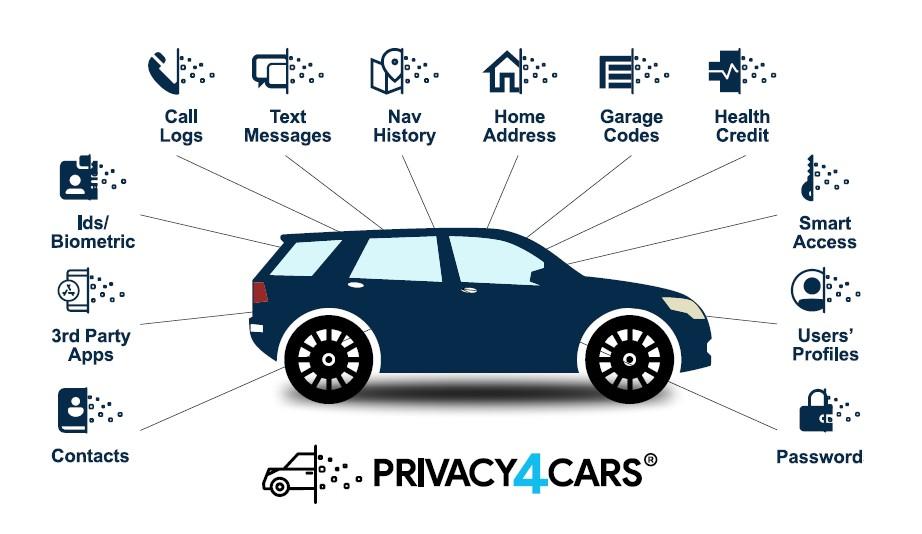
The issue becomes even more complex in the end-of-life phase of the vehicle, also in light of the evolution of the End-of-Life Vehicles Directive. The electronic systems present in vehicles – control units, infotainment, memory modules – can continue to contain personal data even after decommissioning, creating potential exposure.
However, according to the GDPR approach, operators such as dismantlers and recyclers are not automatically data processors: they only take on this role when they receive a specific assignment to delete data.
This opens up two critical scenarios: on the one hand, the need to integrate data erasure into dismantling processes when required; on the other, the risk – often ignored – that personal data may remain accessible in discarded components, at a stage of the supply chain where responsibility is less closely overseen.
WHAT OPERATORS REALLY NEED TO DO: FROM THEORY TO COMPLIANCE
If the regulatory framework is now defined, the problem is fully operational. The deletion of data cannot be an ancillary activity. It must become a structured phase of the vehicle’s life cycle. This implies a change of approach. First of all, it is necessary to formally recognise its role as controller as soon as the vehicle comes back into the company’s possession.
Hence the need to define clear and consistent internal policies. On a technical level, deletion takes place through precise logical operations – reset, overwrite, guided procedures – which must be tailored to the specific vehicle. There is no universal procedure.
For this reason, the process must be designed to be objective and repeatable. It cannot depend on individual expertise. But above all, it must be traceable. It is not enough to delete data. You need to be able to prove that you have done so, documenting the vehicle, the operations performed, the time and the outcome. This is the real leap required by the GDPR: from good practice to documented evidence.
MOTORISTS’ RIGHTS: STRONG PROTECTION, WEAK AWARENESS
On the user side, the framework is legally sound but operationally fragile. Motorists have the full right to have their personal data deleted, even when it is stored in a company or personal vehicle. However, in most cases, there is a lack of awareness of the problem.
They can theoretically request deletion even after handing over the vehicle, but this right remains difficult to exercise without transparent and verifiable processes. This leads to a possible evolution of the market: the introduction of certified vehicle data sanitisation practices (see Privacy4Cars), capable of objectively certifying that the data has been removed before the transfer to a new user.
The point is no longer whether data in vehicles should be managed: this is already established. The point is that the automotive supply chain today is not yet structured to do so. The risk is not episodic but systemic, because it arises from a profound misalignment between technology, regulations and operational processes. Cars have become digital assets, but they are still treated as physical objects. Until data management is integrated into industrial processes – with adequate standards, responsibilities and tools – non-compliance will remain a real possibility. And one that is increasingly difficult to defend, not least from a legal standpoint.